
FROM IDEA TO ACTION
Depression, burnout, boreout, brownout… Unfortunately, all these terms relating to lack of wellbeing among employees, leaders and business owners, are still a common presence in our everyday life. Companies are continuously working to boost their performance, to be more effective and efficient, while offering an organizational culture, work environment, remuneration systems and corporate values in today’s challenging context where companies have to compete for skilled workforce that is becoming increasingly scarce. It’s no easy feat! The very way to manage businesses and to lead people has to be rethought. We have seen a succession of management approaches like leadership coaching, participatory management, circular management, etc. Now the term Equitable Management is gradually making its way into organizations.
What Is Equitable Management?
According to the Association française du management équitable (Equitable Management Association of France – AFraME), equitable management is a set of practices rooted in the notion of achieving a fair balance between economic and/or operational performance of a company and personal fulfillment in the workplace. AFraME has put together a comprehensive Equitable Management Charter. Here are a few of these principles. (View the complete Charter) [i]
AMBITIOUS AND EXEMPLARY COMPANY
PEOPLE-CENTERED MANAGEMENT
RESPONSIBLE AND INVOLVED MANAGERS
ETHICAL AND SOCIAL COMPANY
People Are at the Center of Equitable Management
The principles that form the foundation of equitable management are commendable. The main goal is to put people first. So far so good. I’m sure that most of us would agree with this. However, it may get tricky when it comes to acting on it.
Any people-centered approach also implies relational and communicational challenges. Communication is and will be always a challenge at the heart of any organization regardless of the organizational culture, management practices and the best intentions of its leaders. Each person is unique. We have our own views, our experiences that make us who we are, our personality that defines us, our ambitions that guide us, our fears that hold us back, and our current personal reality that explains the difference in our perception of the same situation.
Interesting… But Gets Complicated
As if it were not already complicated enough, we also have fundamental needs that we are seeking to fulfill. Neuroscience identifies five basic human needs. While these are the same needs for all human-beings, the significance of each of them is different for every individual. According to the SCARF Model by the NeuroLeadership Institute[ii], the five basic human needs are (simplified SCARF Model):
S (Status) having a certain status, feeling that we have our place in the organization and being happy with it
C (Certainty) being able to foresee the future
A (Autonomy) having a certain level of control over our environment
R (Relations) having a relationship with other people, being part of a group
F (Fairness) feeling that we are treated fairly
In fact, when we find ourselves in a situation that does not meet or even negatively affects one or several of these needs, our brain perceives it as punishment or aggression, which leads to gradual disengagement or disillusion towards the situation, the colleague, the manager and the company. The opposite is true too. If we find the work environment fulfilling, we feel happier, more successful and engaged.
We observe strong coherence between the principles of equitable management and the SCARF Model. It leads me to conclusion that the principles of equitable management are a great solution for our basic human needs. Great! However, these principles, as great as they are, must be well supported by processes, rules, profound and sincere exchanges to ensure that everyone in the organization has the same understanding of their meaning, the same awareness of the basic needs of everyone involved not only prior to the implantation of the equitable management process, but on a continuous basis.
Life does not stand still. As people go through various situations such as economic challenges, family issues, etc., the weight of each of the basic needs would change accordingly. That would require having a mechanism in place that could ensure that the effects of any particular decision on each person are continuously taken into consideration and updated. One of the biggest mistakes would be to make assumptions based on previous experiences.
A Continuous Solution

In addition to integrating the principles of equitable management and considering the five basic human needs in the policies and procedures of your company, it is also recommended to set up a mechanism to address the human factor, such as a decision-making tool that would take into account the individuals who would be directly or indirectly affected by such decision, while bearing in mind the company’s mission, vision and values, as well as the principles of equitable management, the company’s objectives, and the SCARF needs of its employees and leaders. In the heat of the moment, it’s easy to forget the person!
Sylvie Grégoire, MBA, CRHA, NeuroLeadership Certificate
President, Totem Performance organisationnelle
[ii] http://www.neuroperformance.fr/le-modele-scarf/
 Vacations are over, school is starting… this time of the year is synonymous with growing activity, launching new projects and picking up where you left off.
Autumn is in the air; cool breeze announces the change of seasons upon us. Since centuries, autumn has been often defined as the time that precedes old age. In Alchemy, it is symbolic of transition and culmination. It is a time to take stock of achievements and bounties, when the operation of the Philosophical Egg is brought to perfection.
We feel the bustle of life, at home and at work. We make the most of this season – when we are full of energy and vitamin D – to accomplish as much as possible, as if stocking up in preparation for the recluse of the winter months to come.
But as we throw ourselves into work, the wheels of day-to-day operations spinning faster, we tend to lose sight of our goals. That’s why it would be of great help to have a continuous reminder of where we intend to be. It is similar to a personal vision board… You know, the collage of trinkets, mementos and images we hang on the fridge where we can see it whenever we are in the kitchen, which represents our goals and wishes in life, in order to maintain our focus. Well, the same principle applies to our business objectives.
Visualization is a powerful mind exercise, gaining wide recognition for its results. But regardless of all the hype, it is still little applied in business. And yet it works… Olympic athletes have been using it for decades to improve performance. Research has revealed that visualization exercises and the actual physical activity trigger the same brain patterns. It is an efficient way to train our brains to create new neural pathways. And these new pathways can be only built through repetition.
Pausing a few times a day to view our goals, whether presented on a vision board or on the company’s Intranet page, can help identify and clarify our vision, and thus bring us closer to our goals.
But to be truly effective, this visual aid must fulfill a certain condition (as is the case with personal visual boards): it must generate emotions. We have heard it many times, read it in many books, like The Secret, right? It works because there’s a good reason – rationale – to that. We are emotional beings. After all, the emotional brain largely preceded the rational brain. And if there is opposition between feelings and conscious thoughts, it is always the emotional response that prevails.
So, your business goal of reaching certain annual sales is a purely rational, logical target. By adding an emotional dimension to it, which may be the subject of visualization sessions of your employees (for their individual and collective benefit), you may achieve surprising results. As an example, if the sales target is attained, employees would get their Friday afternoon off during the summer time (more time for themselves or with their families), or get access to the gym or spa (valuable personal time), based on their personal interests.
The higher the level of satisfaction of your employees, the more engaged and motivated they are. Thus adding an emotional aspect to the business goal could boost your overall organizational performance.
And according to Alchemy, it is the perfect time to transform matter into a higher form! So, what’s the risk in trying it?
Have a great beginning!
Isabelle Vincelette
Expert in Organizational Improvement
Several years ago, San Diego researchers placed 95 sharks and 5 dolphins in a large pool and let them live together for a week. Guess what they saw when they checked back on them seven days later…
In Part One of the article we presented the three characters in the Strategy of the Dolphin by Dudley Lynch and Paul L. Kordis. Would you like to know the rest of the story and to find out how the strategy applies in the business context?
What Happened in the Pool?
The sharks, blinded by the threat of the unknown and making no distinction, started attacking their own. After a while, there were only a few sharks left and five dolphins in the pool. The sharks turned their attention to the dolphins. These friendly, sociable dolphins meant no harm, yet the sharks only saw enemies. The dolphins used various strategies to show their good intentions, but the sharks continued their attack. Working together, the dolphins circled the sharks. When one of the sharks attacked, the dolphins used their bulbous noses and back fins to ram the attacker and methodically crush the shark’s sides until the sharks sank helplessly to the bottom of the pool one by one.
Did you know that if a dolphin gets wounded, the group delegates four dolphins to accompany their wounded peer to safety? The dolphin is the person who takes ownership of the task, who assumes full responsible for the results, successes and failures alike. He is able to adapt, to surf the wave of change. He is the leader who wants to succeed and to help his colleagues reach the top. He believes he lives in the world of abundance and knows there is always enough for everyone. He welcomes new ideas and consciously adopts the most appropriate strategy depending on the situation. Meanwhile, sharks and carps live in a world of scarcity, of resistance, where there are winners and losers.
In these times of constant change that easily cause storms in the ocean, a major shift is taking place in our society, in our companies, in us. We live in the era of transformation of the leadership role, which requires a lot of flexibility on the part of every player: the owner, the CEO, the management and the employees. You can guess what will happen to the companies and executives who resist change, who cannot adapt…
Are There Many Sharks in Your Company?
You have certainly heard someone (maybe even you!) say that he works with sharks, always in fear to be stabbed in the back at any time, because the shark believes: “For me to win, you have to lose”.
Usually it is the organizational culture that attracts a certain type of personality. You can either drive the corporate culture or be driven by circumstances. The culture and values are usually set by the management. If the corporate leadership establishes a climate of trust that promotes innovation, mutual assistance and collective interests, then a natural coexistence among the employees will reign. Those who share the values of the organization will stay and those who don’t will either leave the company or will be forced out. However, the decision must come from the leaders. Without their support, the change will be difficult, if not impossible.
Often, there are sharks in certain business sectors that encourage the predatory behaviors. But even these sectors are expected to go through changes.
Can the Carp and the Shark Change?
The only constant is change! Of course everyone can change. If there is a will there is a way. Thus, the common carp evolves into the pseudo enlightened carp, who can then transform into a dolphin.
A carp may want to stay a carp, or a shark may refuse to change, but it is in their benefit to learn about dolphins and their way of thinking. Otherwise, they may stagnate and get lost in the stormy seas. Sometimes when sharks meet a dolphin, they mistakenly think that they are dealing with a carp. In organizations, many people mistakenly believe they know all about dolphins, yet they hardly understand the specific characteristics of this personality. Until recently, many were unaware of the presence of a dolphin in their organization. How can they learn to be a dolphin themselves then?
A smart shark could understand that he cannot win against a dolphin (still he must recognize this fact) and could be open for cooperation. For thousands of years humans have been resorting to a confrontational behavioral style that encourages resistance. This is what sharks are used to, this is what they expect. Instead, a dolphin speaks from the heart. His nonconfrontational attitude throws sharks off balance and disarms them, causing them to change their perspective, adapt their ways and be themselves. But first, the shark must want to change. But not all predators are the same. We invite you to read our article on toxic leaders.
Applying a Dolphin Philosophy
How do we improve the attitude of the carp and the shark, and optimize that of the dolphin? As mentioned earlier, a company that has existed for a long time has (or will have) an organizational culture that values integrity, authenticity, transparency, innovation and encourages initiative. However, by encouraging initiative, we can expect improvements and success, but also mistakes. But don’t get discouraged: penicillin, pacemaker, microwave and even potato chips were all a mistake once! To err is human, and it makes us better. There are no failures, only learnings!
Know the expectations of your employees as well as their motivations. This will help you delegate effectively and choose profitability objectives accordingly. An employee who achieves his goals has an increased level of happiness and a sense of wellbeing. He does not need to put others down to feel better. He knows he has the power to advance.
Make sure you are fair. Make sure you have a code of ethics, a manual of standards and procedures, which were read and understood by all employees. Make sure you have a remuneration system that encourages teamwork rather than individualism, e.g. a bonus system based on the results of their department.
Let’s dolphinize[1] our business, promote cooperation, abundance, continuous improvement, consciousness and happiness in the workplace! And above all, let’s make it enjoyable!
Isabelle Vincelette, Experte amélioration organisationnelle et coaching
[1] Expression borrowed from “Water the Flowers, Not the Weds” by Fletcher Peacock
“The Strategy of the Dolphin: Scoring a Win in a Chaotic World” book by Dudley Lynch and Paul L. Kordis was first published in 1990… 27 years ago! And yet, this concept is still very viable today.
The chaotic world that the authors referred to then had little in common with today’s reality. Now life speeds up at a faster pace than ever before in the history of the human race as new technologies, including the Internet, spread rapidly. Recently, Le Devoir published an article “Le Québec en état de surmenage social” (Quebec’s Social Overwork). It is not surprising that the topic of happiness at work is continuously among the top searches. Our article “Surviving Toxic Leadership” posted last September became an instant hit among our readers…
Inspired by the book, we shall focus on the following two subjects:
Part One
THE STRATEGY OF THE DOLPHIN: UNDERSTANDING THE METAPHOR
The authors draw parallels between the natural characteristics of the three aquatic species – the carp, the shark and the dolphin – and the human performance in the world of business. Several years ago, San Diego researchers placed 95 sharks and 5 dolphins (no carps, but you will understand why) in a large pool and let them live together for a week. Guess what they saw when they checked back on them seven days later… But first, let’s have a closer look at the animals used as the metaphor in the book to explain human nature and individual behaviors.
The Carp
The common carp is a victim. He fears to be hurt and would flee any potential danger, even if it means sacrificing everything. Often, the carp has lived some traumatic events, and feels trapped in the defeat. Carps prefer the status quo and avoid any change to reduce the risk of suffering. Self-sabotage, self-imposed limitations and fears… they are chronic victims. While carps have the strength to take action, their constant fear of adversity prevents them from coming out from the shadows and taking a stand. At the same time, carps are proud and composed; they rarely voice their opinions and often take the back seat or stay out of the game altogether. They play the nice-guy routine, letting others take the risk and the blame…
Carps believe that they live in a world of scarcity. When confronted with change, their behavior is best described as a get-out and give-in play.
We’ve all been a carp at some point in our life…
There is another type of a carp personality, presented in a more positive light… the pseudo enlightened carp. These people believe in the immense capacities and powers of humans. Unlike their common carp cousins, pseudo enlightened carps believe in a world of absolute abundance. “I believe that all we really need in life is to learn to let go, let the flow carry us, and everything will be fine. It’s just a matter of time before everyone wins. All creatures should love and take care of each other.” One little snag: these people never take action, they initiate no change to avoid any disruption of their environment. In the end, they are hardly any different from the common carp. They think they are dolphins, but since they are often too nice for their own good, they get eaten by the shark.
The Shark
The shark is a ferocious predator, no surprise here! Sharks have no remorse when it comes to winning at any expense, and they make no distinction. For the shark, everything and everyone is a potential threat or competition. They believe they live in a world of scarcity and limitations. They are intolerant, impulsive and always ready to attack. “For me to win, you have to lose.” It is the opposite of a win-win approach. Sharks have several strategies to achieve a personal win, because winning is the only acceptable outcome, whatever the cost: cheat, create panic and confusion by whirling and raising waves, never admit to their faults, distort reality, hoping they will never be questioned.
Sharks have an insatiable lust for power, they seek to control. And for that they maintain a general climate of crisis to keep others feeling dependent on them. Only their vision can be valid. Egocentric and narcissistic, they accept only their own judgment. For sharks, the ideas and solutions suggested by others do not deserve any attention. While they prefer the stronghold strategy, when challenged by a stronger opponent sharks can resort to compromise or trade-off. However, their strategy of control is not viable in the long term.
The Dolphin
Unlike carps and sharks who believe they live in a world of scarcity, the dolphin believes in abundance. While dolphins admit there might be shortage of resources, they choose not to live in fear of it. They are inventive, playful and intelligent. They believe in cooperation and can easily adapt to any changing situation to make the best use of the available resources and to find elegant solutions that would combine precision, consistency and simplicity. Dolphins thrive in tougher environments, using their flexibility and adaptability to achieve more with less. Besides, Cybernetics states that the most flexible person will have the advantage in any situation. The dolphin would not blindly apply laws and principles, but rather advocate strategies that work.
A master of creativity and adaptability, the dolphin will sometimes behave as a carp, sometimes as a shark, depending on the situation. The dolphin works towards a specific goal, knowing all the facts, hoping to achieve improvement, innovation and evolution by continuously pushing the limits, towards a world where everyone is a winner.
The dolphin can control, compromise, give up or give in, show disengagement or noncommitment… But unlike sharks and carps, the dolphin does not pursue his own interests, but works for the collective good. For example, a dolphin can be authoritative, pushy and even go as far as offending some people in the case of a medical emergency (and will take care of mending relationships later once the emergency is taken care of). And when the result is of little importance, a dolphin can become disengaged. The noncommitment strategy may be one of the dolphin’s preferred ones. The Dolphin thus avoids nonconstructive tasks and situations in order to invest time and energy in the true values and goals.
So, what do you think happened in the pool? Well, the researchers found 95 dead sharks and 5 dolphins playing together. How come?
To be continued…
Isabelle Vincelette, Experte amélioration organisationnelle et coaching
 Fifteen millions of Canadians spend 50% of their time at their desk.[1] I was curious to learn more about new, innovative ways that companies use to help their employees and managers stay active in the workplace. If maintaining the mental and physical health of your workforce is not enough to motivate you, consider its positive economic impact on the absenteeism rate in your business. In the past thirty years, this rate has increased by 30% and is largely linked to health-related factors, according to the Canadian Council for Health and Active Living at Work. Physical activity helps to reduce stress that accounts for 19% of the cost of absenteeism, 60% of workplace accidents, not to mention its impact on the risk of heart attack, back pain, anxiety and burnout.[2]
Companies with specific programs and initiatives to promote health and wellbeing of their employees show:
It does pay! The average cost savings per dollar invested in workplace wellness programs is $3.27. Companies now spend an average of $521 per employee per year on wellness incentives.[4] What about you?
INNOVATIVE IDEAS
Businesses now provide bicycle parking racks and shower/change facilities, gym installations, reimburse sports memberships, and provide grants to support corporate sports teams… And some companies go a step further, offering innovative office solutions to stay active.
Health Workshops
Hold nutrition seminars and workshops, invite health professionals, and organize sports events and challenges (CrossFit, jogging, yoga). The rate of participation is up 118%.[5]
Walking Meetings

Instead of sitting down around a conference table, hold business meeting while standing up; even discuss strategies while hiking or jogging.
Stand, Walk or Pedal While You Work
Seventy per cent of people who tried it adopted it.[6] Simply standing up instead of sitting down to work helps to burn 50% more calories. A study shows that pedaling or walking while performing a work task boosts your concentration and information retention.[7] So, why not equip conference rooms with stationary bikes and break areas? Just 50 minutes of pedaling a day, even at a slow pace, makes a noticeable difference in the overall health of employees.


Unconventional Standing Work Areas[8]

A picture is worth a thousand words…
Bonus Points System
Employees collect health/wellbeing points when they practice sports and physical activities, and earn rewards.
Mobile Application
A software app to monitor and track personal fitness level and activities. It is perfect for the computer savvy Gen Y.
Relaxation Room
Quiet rooms to meditate, to get a massage or to receive other relaxation treatments.
Active Personal Workplace or Accessory


 Some ideas are certainly easier and less expensive to implement than others. Small foot-pedal machines or mini elliptical trainers that fit under the desk, mini boards and even Active Desk exercise bikes are very affordable (from $50 for an under-desk pedal trainer to $400 for a FitDesk) and can make a big difference in the performance of your employees.
Sylvie Grégoire, MBA, CRHA
President, Totem Performance organisationnelle
[1] https://canadasafetycouncil.org/fr/les-sports-et-la-vie-active/la-vie-active-au-travail
[2] https://www.economie.gouv.qc.ca/objectifs/ameliorer/ressources-humaines/page/guides-et-outils-20621/?tx_igaffichagepages_pi1%5Bmode%5D=single&tx_igaffichagepages_pi1%5BbackPid%5D=30&tx_igaffichagepages_pi1%5BcurrentCat%5D=
[3] https://canadasafetycouncil.org/fr/les-sports-et-la-vie-active/la-vie-active-au-travail
[4] http://www.lifespanfitness.com/canada/workplace/resources/articles/the-case-for-in-office-active-workstations?___store=canada
[5] http://affaires.lapresse.ca/cv/201309/03/01-4685536-midis-actifs-et-creatifs.php
[6] ActiveDesk, http://www.deskactive.com/
[7] Mathieu, Marie-Eve, Pédaler au boulot, La presse. http://plus.lapresse.ca/screens/32d0e94d-457f-4fbd-950e-b0b03658a728%7CFCxx.vvStD7E.html
[8] 3045217-slide-s-1a-everything-science-knows-right-now-about-active-desks.jpg
Customer Lifetime Value is a helpful indicator which, unfortunately, is still little known or applied. However, do you think that an employee of a small café would treat her customer differently if she knew that instead of a few dollars a week, this customer was in fact representing $14,000 of income during his lifetime relationship with the company? Sure!
Customer Lifetime Value (CLV)
Customer Lifetime Value (CLV), sometimes called “customer capital”, is the present value of the anticipated future cash flows attributed to the customer during his/her entire relationship with the company minus the cost of products and services and marketing costs. This metric differs by customer or by customer type, and is often calculated per cohort (a group of customers who share an attribute or a set of attributes).
Applications and Insights
There are several advantages to measuring CLV. Here are some examples:
Examples
Calculating CLV
The calculation can be quite laborious and also means you should know the cost of new customer acquisition. We can address it on the basis of the lifetime value of customers to acquire or the lifetime value of existing customers. Other elements required for this calculation are not always obvious, such as actual management costs associated with each client group, customer retention rate, customer acquisition cost and so on. True financial formulas are complex, and are similar to those used to calculate NPV (Net Present Value) of a project, but other simpler formulas also exist.
Case Study: Starbucks[7]
Step 1: Average your variables and list constants:
– Average customer sales per visit: $5.90
– Number of visits per week: 4.2 visits
– Average customer sales per week: $24.30
– Average customer lifespan (how long someone remains a customer): 20 years
– Customer retention rate: 75%
– Profit margin per customer: 21.3%
– Average gross margin per customer lifespan: $5,382.94
– Interest rate used to determine the present value of future cash flows (usually between 8% and 15%): 10%
Step 2: Calculate CLV using different methods
Method 1:
52 weeks X sales per week ($24.30) X customer lifespan (20)
= $25,272
Method 2:
Customer lifespan (20) X 〔52 weeks X sales per visit ($5.90) X visits per week (4.2) X profit margin (0.213)〕
= $5,489
Method 3:
Gross margin (5,382.94) X customer retention rate (0.75) / 〔1 + interest rate (0.1) – customer retention rate (0.75) 〕
= $11,535
Using an average of the three CLV equation results, Starbucks’ customer value is $14,099. You should decide which method is the most applicable to your business model. An average of several equations, similar to these Starbucks calculations, helps to reduce the risks.
Examples of Decision
In short, determining the lifetime value of your customers is a valuable source of information to maximize your company’s profits. However, if the calculation is incorrect, subsequent decisions may be inefficient and even harmful to your business. Learn more about our tools to calculate your customer lifetime value and find out how we can assist you to optimize it.
Sylvie Grégoire, MBA, CRHA
President, Totem Performance organisationnelle
[1] Bain & Company
[2] Marketing Metrics
[3] Prédire la valeur d’un client: tout est question de modèle! (tribune) La Rédaction, 3 février 2015, 10:43
[4] www.stratello.com/wp-content/uploads/2015/01/141211_Aria_Infographic_jf.png
[5] www.stratello.com/wp-content/uploads/2015/01/141211_Aria_Infographic_jf.png
[6] Craig Adkins of Zappos in the article “15 Ways for Companies to Increase Customer Lifetime Value” by Graham Charlton
[7] www.optimisation-conversion.com/infographies/comment-calculer-la-valeur-vie-client-ltv-life-time-value
[8] Chris O’Shea, “Do you know the lifetime value and cost of acquisition of your customers?”, Bdc.ca
Performance management is the new hot topic for numerous blogs and discussion forums. This should not come as a surprise considering its role in the overall performance of a company, its estimated cost of more than $7,000 per manager[1], legal repercussions in case of employment termination, and the shortfalls of the traditional formal approach as evidenced by numerous studies (evaluation of competencies and behaviors, employee self-assessment, and linking of individual ratings to compensation decisions)[2]. It is also unsettling that one of the most important assets of any company, its human capital, is reviewed and assessed only every six or twelve months.
Nowadays, in the context where companies promote employee accountability and entrepreneurship, it would be imprudent to put almost all performance review responsibilities in the hands of managers. This approach also goes against the personality of Gen Y and younger workforce who are known for their “right here right now” attitude and a shift in their relationship with authority. They wouldn’t wait patiently for six months or a year to be told what they do right or what they do wrong. They prefer to receive feedback right away. Just think about young people who post pictures or write on social networks and absolutely need to get as many likes as possible right away.
The performance management process is a broad category. It serves to provide feedback, engage employees, analyze developing needs, set individual objectives, etc. Even top performers find this process dreadful. There is a good reason for that: David Rock, the Director of the NeuroLeadership Institute and the author of “Your Brain at Work”, states that performance reviews, such as the ones done by most companies, activate the pain center in the brain which provokes intense reactions from people and causes them to feel under attack.
Employees and managers agree that this process, which ironically is used to evaluate the performance of an individual, is lacking in performance itself…
WHY EMPLOYEES ARE SKEPTICAL
WHY MANAGERS ARE FRUSTRATED
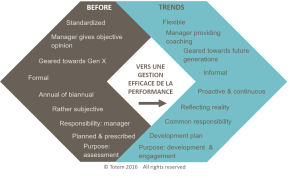
TRANSITION TRENDS
We are witnessing the arrival of major new trends at the level of change management philosophy.
RESULTS SPEAK LOUD AND CLEAR
Companies that abolished the traditional rating-based performance system and adopted innovative solutions saw impressive improvements. Here are a few examples:
SOLUTIONS OF TOMORROW
Organizations look to develop an effective performance review process in accordance with their organizational needs, but also in consideration of the wishes of their employees, representing all generations, according to Harvard Business Review. Employees want to:
Many companies are adopting new performance management models, such as a voluntary approach, crowdsourcing, coaching and peer review. However, be careful not to fall into the trap of copy-pasting the solutions used at other organizations. Finding your own winning formula is essential and, above all, it must be in line with your corporate culture, it must agree with your business processes and it must be supported by skilled managers. Unfortunately, a Mercer survey report shows that managers often lack the necessary skills to properly assist their organization in its performance management tasks: only 3% to 14% are highly skilled, 38% to 65% are moderately skilled, and 21% to 59% are marginally skilled[11].
These alarming statistics reveal the urgent need to give managers the necessary tools and to adequately manage change in order to ensure solid positive results. The Totem team could help you with the design and implementation of a new approach to performance management.
Sylvie Grégoire, MBA, CRHA
President, Totem Performance organisationnelle
[1] An average manager (salary of $60,000/year) dedicates over 200 hours a year on tasks related to performance reviews, Why Employee Performance Reviews Are So Old School, The Washington Post
[2] Global Performance Management Trends, Mercer
[3] The Absolute Guide to Performance Reviews, TINYpulse, Globoforce survey
[4] The Four Question Review to Avoid, Sabrina Son, tumblr.com
[5] The Absolute Guide to Performance Reviews, TINYpulse, Globoforce survey
[6] The Performance Review Trend You Need to Jump On Now, Sabrina Son, August 2015
[7] The Future of Performance Management: 2015 and Beyond, Geese webinar
[8] Trends in Performance Management, March 2015, bridgeinnovate.com
[9] Trends in Performance Management, March 2015, bridgeinnovate.com
[10] The Absolute Guide to Performance Reviews, TINYpulse, Globoforce survey
[11] Percentages vary depending on the surveyed areas relevant to performance management
To error is human… we all know this saying. Even celebrities who are known for their success stories had their share of disappointments earlier on in their careers, for example…
We are under so much pressure to succeed both personally and professionally that, for fear of disappointment, many people prefer to take no risks to avoid any potential failure. But in the business context, most of the time, experimenting and embracing failure’s lessons are needed to achieve success.
“I’ve missed more than 9,000 shots in my career. I’ve lost almost 300 games. 26 times, I’ve been trusted to take the game-winning shot and missed. I’ve failed over and over and over again in my life. And that is why I succeed.” Michael Jordan
Michael Jordan couldn’t have said it better. Accept your failure and discern the reasons in order to improve. So, why Québec companies find it so difficult to see mistakes in a positive way? Missing your target numbers could be spun off into better performance later.
A step ahead, the U.S. saw the launch of events like FuckUp Nights and Fail Camps that give entrepreneurs a platform where stories of failed businesses and projects can be shared, studied and embraced – all with the goal to learn from their mistakes. This movement is also starting to catch up across the Atlantic (FailCons, Conférence du rebond) to help lift the stigma of failure and replace it with freedom, confidence and support, but above all, to share tips and tricks to prevent similar mistakes in the future. It requires a healthy dose of humility from entrepreneurs, but they understand how constructive it could be.
Success and failure should be both viewed as results, one is positive and the other one is negative. They are both consequences of a process or a procedure and can become a learning experience. Hungering for success or fearing failure is of little use. The key is to reinforce a culture that counteracts the blame game, supports employees and prepares grounds for their success by gradually reframing our perceptions of success and failures and transitioning towards a work environment that encourages people to try as hard as possible, and by ensuring that the corporate culture embraces the right to make mistakes.
To optimize transition from failure to success, your organization could implement strategic or operational mechanisms that would 1) help its employees to effectively deal with issues they face, 2) encourage its employees to overcome their fear of failure, and 3) make sure that hits as well as misses become a learning experience for everyone in order to avoid repeating the same mistakes, promote initiative and cultivate successful efforts within the company.
Depending on your business expectations and corporate culture, there are several possible solutions, such as:
These initiatives can be only useful if they are supported by:
Nowadays, mentality is changing, mistakes become accepted. Yet companies must find ways to boost initiative and to give confidence to their employees.
Businesses can:
To sum it up, learning from failure on a business scale is like playing chess: accept risks, build a strategy and anticipate your opponent’s moves. But it also means acknowledging the possibility that you may lose. Remember, everyone may fail, so do your utmost best to avoid disappointments.
Empower your employees to succeed. It means let them try and test their abilities, gradually building up their confidence to take on more complex tasks. It also means support and assist them throughout various challenges, helping them deal with issues effectively and efficiently. Encourage them and celebrate their successes. Finally, if you still think: “I’m lucky, my staff and I make very few mistakes”, ask yourself:
If you answered yes to at least one of these questions, our Totem team can help you to develop and implement strategic and operational practices to boost the efficiency of your business.
Sylvie Grégoire, MBA, CRHA
President, Totem Performance organisationnelle
Organizations face increasing instability that sets hurdles to their effective management and attainment of performance targets. There are several solutions that could help your company improve its ability to achieve excellent results despite the turmoil: improve the efficiency and effectiveness of its people, optimize its production, etc. But any optimization strategy must be backed by a creative, innovative process that is, unfortunately, often neglected by too many businesses. By definition, creativity is the ability of an individual or a group of individuals to design or implement a new project, to create a new physical object, or to find a novel solution. Thus, companies can find the best strategy and tactics to stay ahead of the competition and to ensure their sustainability.
We often tend to associate business creativity with the skills and traits of the people within the company. Yet, more and more studies show that creativity is not reserved for the chosen few with special qualities. Researchers and leaders believe that creativity can be learned, mastered and controlled, and that there is a very strong correlation between business creativity and performance. Another good reason to formalize this practice is making up for the stereotypes leading managers to see supporters of the status quo as more effective. According to the authors of the article Plafonnés les leaders créatifs?[1], ‘creative types’ seldom get to the top management spots because, unlike ‘effective leaders’, they don’t crave stability and are often perceived as less reliable to ensure effective management. By implementing a formal creative process, companies establish a favorable framework for innovation thanks to a clear structure that offsets the natural inclination of the top management to foster a stable and secure environment, and thus optimizes the results.
“Performance is 90% the system and only 10% the individual.”[2]
Designing and implementing a creative process should not be taken lightly. If badly planned and poorly executed, its cost to the company will be higher than the actual gains it generates. Here are some examples of the criteria to respect:
Involve the Right People at the Right Time
It is important to involve the right people depending on the nature of the desired innovations and the stage in the process. According to researchers, it is possible to train and strengthen our brain to create new pathways that will enable us to be better at creativity.[3] But some people have a natural ability to generate ideas and to support creativity with winning tactics. They are at ease with risk-taking associated with innovations or hold information that is essential to generate ideas that are not only innovative but also useful to customers. A useless innovation will of course have no impact on the company’s performance. A creative process involves several steps, each requiring a different set of skills. Idea generation, feasibility analysis, idea prioritization and project finalization all call for distinctive skill sets. The process should involve people with complementary skills to ensure the success of the selected strategies.
We all had to deal at one point with creative leaders who lacked focus, thus making their teams lose a lot of time by continuously suggesting new ideas, yet never seeing any of them through. While such organizations appear highly creative and are skilled at generating ideas, they actually implement very few of them because these ideas are either refused or ignored or simply replaced by something new. The consequences can be disastrous because their key employees become demotivated and lose interest in the innovation and even in the company itself. The creative process helps to make the most of the incredible potential of all employees by structuring the process, thus allowing to maximize actual financial results. Having a structured process in place is proof that the senior management privileges innovation.
Mitigation Tactics and Tips to Improve Creativity
Creativity can be slowed down by several factors. A good creative process should include tactics that could mitigate, even eliminate, such factors.
These two statements make it possible to open the door to new ways that go against conventions.
“A person who never made a mistake never tried anything new.” Albert Einstein
An Open Mind at the Core of Innovation
Before, most of innovations used to be about improving or adding business services and products. But not anymore. Nowadays, the innovations that are often the least costly and the least risky to implement are those dealing with, for example, the originality of the business model. Indeed, a recent survey of 4,000 senior managers by the Economist Intelligence Unit found that 54% favored new business models over new products and services as a source of future competitive advantage. For example, rethinking how products are offered, how resources are used, or radically transforming the business model (such as the case of a company in a declining industry sector) must certainly be supported by a solid, sound process. Here are some real-life innovations that prove that fundamental changes can be very profitable for their organizations and especially useful for their customers.
Reward Innovation
To foster a creative environment and to highlight the importance of innovation in the business strategy, organizations need to design and link a rewards and recognition program in order to raise the awareness and motivate employees to pursue creative and effective ideas.
In conclusion, it is important to support the organization through a creative process to ensure that sufficient time and resources are dedicated to innovation and that the investments turn into revenues.
Sylvie Grégoire, MBA, CRHA
President, Totem Performance organisationnelle
[1] Magazine Premium #10: A study of 364 employees at a refinery, whose jobs required them to find innovative solutions
[2] Jules Goddard: Experiments in Management: Business Strategy Review
[3] “Creativity Unlimited: Thinking Inside the Box for Business Innovation” by Micael Dahlén
[4] William Duggan, researcher and senior lecturer at Columbia Business School
[5] Adrian Wooldridge, Management Editor for The Economist magazine
So many consultants, books and articles have been touting the importance of using key performance indicators (KPIs) to measure business success. However, if misused, KPIs become ineffective when it comes to optimizing company performance, even harmful in the long term. The Totem team decided to investigate the positive and negative aspects of KPIs. As a result, here are several tips to help you avoid some blunders.
Our first tip sounds rather simple and straight-forward. Today’s managers on average measure 25 to 40 key performance indicators compared to 5-7 in 1955, when only some management teams applied such metrics. So, do we progress or regress? What is the optimal number of KPIs? There cannot be a one-size-fits-all answer since individual needs depend on the actual context. However, we see a trend: companies tend to add new KPIs based on their circumstances at the time. The system gets heavier and more complex. No doubt, KPIs are a key factor of success, but at the same time, you must make sure that you build and optimize your KPI dashboard in accordance with your strategic objectives. This means you must take a step back from time to time to analyze your KPIs and to keep only those that are actually relevant to your current business. Choosing to target and monitor only specific KPIs saves valuable time for your managers. Yet, if one or several of your KPIs do not produce the expected results, then breaking them into several smaller KPIs would help you identify the exact area for improvement.
There are two sides to every indicator. On the one hand, it allows to evaluate the performance of a specific element that you judge important in your business. On the other hand, it may lead to actions on the part of your employees that are not necessarily in line with your other objectives. For example, measuring your sales in dollars per month may result in loss of motivation among your representatives once the monthly targets have been achieved, thus striking a blow to your annual sales, or it may tempt them to offer excessive discounts to inflate the sales numbers, ultimately reducing your business net income.
Here is a real-life example showing how things can go really off-track: one police force introduced KPIs to measure its performance. As a result the chief pressured his team to prioritize burglaries of multiple-occupancy households, instead of their gravity or date, because the system would count each occupant as a separate solved crime and therefore give the appearance of a better performance.[1]
This does not mean you should stop using KPIs. But you must question the pertinence of your selection to make sure:
“People do what their management inspects, not what it expects.”[1]
Following the KPIs, which you have meticulously selected, properly measured and effectively presented in a dashboard, seems like the right thing to do. However, remember that your KPI dashboard should remain flexible. Often out of habit, we keep using the indicators that focus on our strategic objectives towards our vision – we measure our process, our staff efficiency, etc. – however without questioning the pertinence of the initial plan altogether. Sometimes, you need to be able to step aside from the dashboard to evaluate the current context and, if necessary, to update your plan. Today’s economy is evolving at a rapid pace, which dictates the need for an adaptable tracking tool that would make sure that noncurrent indicators, once their associated targets have been achieved, do not give a false impression of success.
Resist the temptation to choose your KPIs based on the top 10 performance indicators of 2015, like “The proven metrics of business success”, “The best and worst KPIs”, etc. OK, we invented these titles, but they are representative of the numerous articles on the subject.
Your business is unique! A KPI that is perfect for one company may not be suitable for another. We customize our products, our services, our communications, what not… So why not customize our performance measuring tools based on our organizational context?
Assurant Solutions, a U.S. company providing specialized insurance products, dared to address KPIs in an innovative way. Trying to get a better perspective on the performance of its call centre, the company called on mathematicians and actuaries to examine the data using a modeling tool. However, they focused only on facts and rules-based analytics, ignoring basic management principles. So the company turned to a model-based system that analyzed the attributes and variables of calls to measure such metrics as the retention rate of unhappy customers or those shopping around for a better deal, as well as the call wait time. Initially, the marketing team assumed that shorter call waiting would translate into a higher acquisition rate. Instead the analysis showed that:
How do you explain the fact that many companies ask their management to rigorously measure their KPIs, but do not give them the power to act? If the decision-maker or the team does not have the means or does not feel concerned by a certain metric, it is better to avoid adding this KPI to the dashboard. Otherwise it will create clutter and discourage the management. An indicator is a performance measurement tool; it is not a guarantee of success. An indicator must come with concrete steps to bring the process in line with the objectives. Give your employees freedom to act instead of burying them under endless approval processes that only delay your goals.
Performance indicators alone do not guarantee success. The strategic selection of indicators based on your strategic objectives, as well as the measurement process and the decision-making process associated with them will greatly impact the performance of your company.
The Totem team can provide assistance and support:
Sylvie Grégoire, MBA, CRHA
President, Totem Performance organisationnelle
[1] Bernard Marr, a bestselling author, keynote speaker and leading business and data expert, in his blog “Caution: When KPIs Turn To Poison”

