

Source: https://www.recyc-quebec.gouv.qc.ca/citoyens/mieux-consommer
We often hear that Quebecers are recycling champions. The 4Rs principle of sustainable development: Reduce, Reuse, Recycle and Recover… But today I would like to talk about the importance of the waste management hierarchy. Besides, I believe there is yet another R (Rethink) that must be added to the known 4Rs of waste management. It is about reviewing and rethinking our needs. It must become the very first step of resolving waste management problems. I’ll show you that we can transform costs into savings by moving away from the waste treatment approach towards waste prevention, or in other words by focusing on Rethink, Reduce and Reuse!
Question & Rethink
One SME leader working in the service sector told me that the challenge of “raw and waste materials management” is not relevant in the case of his company because there is already a recycling bin in every office. However, after we talked for a few minutes, we realized that all employees were scheduled to get a new laptop every 2 years.
Me: Why do you upgrade all laptops every 2 years? Is there a real need for it?
Manager: Silence… Well, it’s in the agreement we signed with our provider… But we do recycle the old ones!
Me: Do you think that you could both generate savings for your company and reduce the negative impact on the environment if you were to have your laptops upgraded based on the actual needs of your employees instead of a predetermined fixed replacement schedule?
You can imagine the rest of the conversation. This process of questioning your current business habits and rethinking your established processes can be done for all input (raw) materials. While responsible waste management is a good thing, it’s still waste treatment. Yet true cost savings are in prevention, which means focusing on and dealing with the input materials.
Does it sound familiar? What are the potential savings for your company if you review and rethink your consumption based on YOUR ACTUAL NEEDS?
The 5Rs – Recycling Hierarchy
So what is the waste management hierarchy all about? Here is a table that lists, in order of preference, the actions that are both profitable for your business and good for our planet.
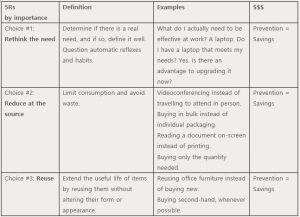
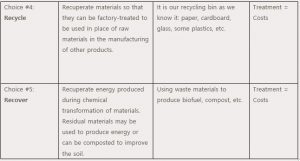
Based on: “Principes et mesures d’approvisionnement responsable: contribuer au développement durable par ses décisions d’achat” by STM (Principles and Methods of Responsible Procurement: Contribute to Sustainable Development through Purchasing Decisions) https://www.stm.info/sites/default/files/pdf/fr/appro_resp.pdf
All these options are better than landfills and disposal sites, but they are listed in order of importance and profitability. Indeed, goods that don’t have to be purchased because the need was rethought, their consumption was reduced at the source or they were reused (which imply savings), also do not have to be recycled (thus avoiding costs that result in savings).
Be a Responsible Business
On the website of the Ministry of Sustainable Development, Environment and the Fight against Climate Change we learn that:
”On average, Quebecers generate 25 tons of non-hazardous residual materials per minute. Despite the educational efforts and the means offered to the public, municipalities, as well as industrial, commercial and institutional establishments in order to enable them to reduce their production of goods and reclaim their waste, still too many consumer products are ending up in landfills and disposal sites…. In fact, some 13 million tons of residual materials produced in Quebec annually hold undeniable potential to be used both in the manufacturing of goods and for energy production.”
Reference: http://www.mddelcc.gouv.qc.ca/matieres/inter.htm
I absolutely agree with the idea of avoiding the landfill end of life of goods, but I would rather prefer to see the focus shifted towards the importance of the steps that precede recycling. Why not rename RECYC-QUÉBEC… to be more coherent… 5R-QUÉBEC? Seriously, whether you’re a manufacturing or service company, it is possible to focus on prevention by reviewing all input materials and goods to be able to offer your products/services, to organize events or to meet the needs of the employees: electronics, office furniture, cafeteria, bottled water, supplies, etc.
A simple way to get the attention of your colleagues is to give them the annual stats on the volumes and costs related to the management of residual materials (businesses are charged for recycling and trash containers and related services (quantity and price)). As we all know, the first step towards change is awareness.
Informed Decisions, Not Imposed Changes
Consumers and businesses alike have all the right to manage their own rate of consumption. It is up to us to identify our needs and to make educated choices in line with our values, our resources and our restrictions. What’s the link with the 5Rs of waste management? Enough with the culture of disposable goods and planned obsolescence! The very definition of sustainable development (“development that meets the needs of the present without compromising the ability of future generations to meet their own needs”) focuses on the “needs”. But what does a NEED mean? Having the latest iPhone model… is it a need or a want?
The problem starts when the “need” is imposed on us by planned obsolescence. Examples? According to the article on Planned Obsolescence published by GaïaPresse:
According to the same source:
Source: http://www.gaiapresse.ca/2018/01/obsolescence-programmee-grand-gachis/
So, how much do you think your company could save by simply applying the principles of this 5Rs hierarchy? I challenge you to make your own calculations…
Marie-Josée Roy
Sustainable Development & Strategic Management Expert
Totem Performance organisationnelle
ISO standards have to bear a great deal despite their many revisions and improvements over the years. “It must be done because of ISO compliance”, “way too complicated and effort consuming”, “tons of useless paperwork”… if this is what comes to your mind, you are due for a reality check: your management system either misunderstood or is poorly adapted to the specific context of your organization. Management systems in general and ISO standards in particular, often create a lot of frustration as the bulk of complexity and weight comes from imposing requirements without further questions about the reasons and goals. What if we stop doing it for ISO and instead look for added value of each of our initiatives? What if we do it to put the customer at the heart of our business in order to improve profitability and to make the workplace more engaging and tasks more streamlined and pertinent for our employees?
What Is a Management System?
According to ISO 9000, a management system is a set of interrelated or interacting elements that organizations use to formulate policies and objectives, and to establish the processes that are needed to ensure that policies are followed and objectives are achieved.
The diagram below is a good example. In fact, the challenge is to synthesize the functioning of OUR organization.

Source: http://qualite.master.utc.fr/site_public/travaux/2011/qpo/QPO12/04_graine_qualite/index.html
Key Benefits
An organization that implements a quality management system, for example, could see the following benefits:
The Strength of a Management System
Whether certified or not, the strength of a management system is not in its certification but in its application. Obtaining certification is a business decision on account of customer requirements, competition trends, strategic planning or effort recognition. Using a common set of standards would be the most efficient way to do it to avoid reinventing the wheel every time and to ensure compliance with a certain minimum level of requirements. It is a bit like getting a diploma. Yet even if this decision was forced by external factors, still it must be in line with the actual needs of the organization.
Another reason would be performance improvement. ISO standards provide a summary of requirements that organizations must understand, interpret and adapt to their reality. It is no easy task. For example, Management Review Clause 9.3.1 (ISO 9001: 2015) states:
Top Management is required to review the quality management system at planned intervals to ensure its continuing suitability, adequacy, effectiveness and alignment with the strategy of the organization.
As head of the quality management system (QMS), how do you understand this requirement? What would be the best way to present its benefit to your colleagues? If you ask me, I would make sure I convey to the Top Management the importance of reviewing the QMS results, because after all a lot of time and resources are invested in it. So, why not integrate management reviews in the scheduled quarterly management meetings, if applicable, with the goal to review everything over a period of a year?
Process Approach: at the Heart of the QMS
A process-based approach is one of the foundations of the latest versions of ISO. It is one of the improvements with the most potential for added value since it allows seeing, understanding and revising. What are your key processes? Do they deliver the expected results? The essence of your system is to represent your organization as a set of interrelated and interacting processes, aligned with its mission and focused on its customers. For example, for the Procurement process, we identify the person in charge, inputs, activities, expected results and performance indicators, and relations with other processes.

Schematic representation of the elements of a single process
Source: ISO 9001: 2015
We can thus identify individual elements of our process and eliminate any obsolete elements. Such obsolete elements could be a monthly report that has been prepared for 2 years now but no one uses anymore, outdated work instructions, elements that create no added value for the customer (to be a value-added element, the customer must be willing to pay for this element), etc.
Key Steps
You must start by assessing your current situation to identify the gaps with the ISO requirements and the strengths you can build on. Every organization has a structure that can be used as a foundation. Moreover, your people will feel encouraged and engaged.
Then use the results of your gap analysis to plan for the implementation of the elements needed. Do not underestimate resistance to change, which is the normal human reaction in times of change. While your employees do not need to know ISO clauses, you may want to give them examples in connection with their actual work tasks: benefits for the customer, risk reduction, skills improvement, fewer complaints, etc. Be creative and find new ways to conduct internal audits. If year after year, you ask the same questions to the same people every time, you are missing opportunities for improvement and motivation.
Implementing and maintaining a system requires a great deal of energy to manage change and of creativity to keep your troops motivation while staying on track. We shall discuss this subject in more detail another time.
What else could you do to jazz up your management system? Every year, you streamline and review your processes, you find new ways to keep your employees informed, you integrate your systems instead of working in silos (e.g. quality, environment, and health and safety in the workplace), you use job shadowing to train new internal auditors, etc. Be creative and have fun improving your business performance! The results may surprise you.

Source: fotomelia.com
Some Facts:

Marie-Josée Roy, Eng., M.Env.
Expert – Strategic Management, Performance and Sustainability
Totem Performance organisationnelle
Our previous articles on sustainable development mainly focused on its impact on the overall organizational performance, considering the economic, social and environmental dimensions of business management. We also presented several organizations who had successfully integrated sustainable development in their strategic decisions. In this article we will discuss a continuous improvement principle – which is at the basis of the BNQ 21000 standard – mainly aimed at the organizations wishing to gradually implement concrete elements that would enable them to become more responsible, sustainable and profitable.
BNQ 21000: A Standard for Continuous Improvement
The BNQ 21000 standard draws on the best practices (AFNOR, ISO 26000, etc.) as well as on the 16 principles set out in Quebec’s Sustainable Development Act, and applies them to the challenges the organization faces. Its language and tools are aligned with the current realities of business executives. The main tools to integrate sustainability into your business operations are available free of charge at www.bnq21000.qc.ca: implementation guidelines, a self-evaluation checklist (4 categories: social, environmental, economics and moral), as well as an overview of the best practices.
To support the BNQ 21000 standard, a team of 45 authors under the direction of Jean Cadieux and Michel Dion, both professors at the Université de Sherbrooke, wrote the handbook Manuel de gestion du DD en entreprise: une approche progressive. Mr. Cadieux was the BNQ 21000 leading researcher. This handbook describes in further detail the practical tools that first allow to identify and analyze the risks and challenges for the organization in order to recognize its current status and functioning, and then make an informed strategic decision to gradually advance towards a sustainable and responsible organization.
One of the key tools is a self-evaluation checklist that operationally transposes the best practices to be adopted by responsible organizations. The higher the score, the stronger is the commitment of the company to SD principles in its day-to-day management. The checklist allows the team to identify the current maturity of the organization according to each of the 21 challenges identified in the standard. These challenges are essential for any organization that aspires to be competitive, sustainable, profitable and responsible.
One of the challenges is to take a step back to complete self-evaluation as a team before taking action. Although for people of action, taking time to draw a realistic picture of the organization may seem optional, how can we take actions and track our progress if we don’t know the starting point? Another important motivational aspect of self-evaluation is to highlight the strengths which the team could build on to move forward. Indeed, some organizations may be applying certain SD principles without even realizing it, and this can be used as the foundation for further work.
Strategic Challenges
You will see that the 21 challenges listed in the standard should be taken into account by any organization committed to its success, to its stakeholders and to the environment where it operates. They include the strategic, profitability, social and environmental aspects of business.
Moral or transversal:
Economics:
Social:
Environmental:
It is recommended to address and evaluate all the issues, even if some may seem less relevant. The issues will be then prioritized based on the individual business context.
Next Stage after Self-evaluation
An overview of the best practices, or the Management Guide for a more complete list, will set the team on the improvement path by suggesting actions in accordance with the level of advancement. Based on its strategic planning and resources, the organization can then prioritize the issues and prepare a customized action plan. The challenge here is to clearly define an action plan, naming a leader, a measurable goal and deliverables for each action. Motivation and commitment of senior management, tracking of the deliverables, achievement and progress measurement, and communication are all important factors to ensure business continuity.
Continuous Improvement: Philosophy behind the Standard
The philosophy at the heart of the standard is the development and progress of the organizational culture. Companies must first build a culture of performance measurement, then move towards a culture of learning, which in its turn is necessary for the emergence of a culture of continuous improvement. It is not about the destination, but about the road to get there and beyond. It is an on-going process that guides the decisions and actions of organizations so that they can advance in their development based on the priorities identified using the self-evaluation tool and according to their business realities. One way to give momentum to continuous improvement and to keep the troops motivated is to complete annual self-evaluation as a team and to adjust or to step up its measures.
In addition to self-evaluation, the guidelines give access to many of the best practices that can be implemented by organizations wishing to move towards the idea generator level. The Totem team can support you in the evaluation of your company, in the prioritization and implementation of actions to ensure profitability and sustainability of your business development.
Authors:
Sylvie Grégoire, President
Totem Performance organisastionnelle
Marie-Josée Roy, Expert in Sustainable Development and Strategic Management
Totem Performance organisationnelle
and
Jean Cadieux
Professor, Université de Sherbrooke, and
Leading Researcher, BNQ 21000 and Sustainable Development
(Business Efficiency and Social Responsibility: it works!)
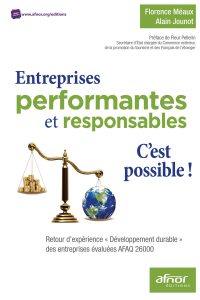 Even nowadays, some businesses still mistakenly think that commitment to social responsibility may hurt their financial results. This book uses facts and real-life cases to prove that social responsibility and business efficiency can effectively coexist. The authors surveyed some 500 French companies to analyze the effect of sustainable development on their capacity to create added value and to boost business performance. The results showed that in fact this approach improved their corporate reputation and image, optimized their business agility, flexibility and capacity to bounce back, etc.
“What does it serve man to win the Moon if he loses the Earth?”
François Mauriac, French writer (1885-1970)
Michael Porter changed our perception
Professor Michael Porter of Harvard University recognized the limitations of past business models and put forth a new CSV (Creating Shared Value) concept. It is a business strategy which seeks to create economic value in a way that creates global social value at the same time. Like many others, Porter believes that there is an intelligent way to bring together corporate social responsibility and value creation for all stakeholders.
Quebec’s Standard BNQ 21000 is an example for French companies
Although the book draws on the statements by French companies and firms using ISO 26000, it also cites the BNQ 21000 as an example to follow.[1] The BNQ 21000 is represented as an approach adapted to SMEs, unlike ISO 26000 which is more complex to apply. One thing is for sure: both standards are based on the strategic evaluation of the business vision, mission and values, as well as on the identification of issues and challenges.
Conclusions of Top Performers
Through the analysis of real-life corporate cases, the authors observe that CSR (Corporate Social Responsibility) is a way to ensure business sustainability. The book shows that a company that considers stakeholders in its decisions will be more efficient than a company that does not.
The results of the Generali-CSA survey show that, in the face of new corporate challenges, 88% of decision-makers are motivated by meeting customer expectations, 80% by the improvement of the economic performance of their business, 68% by the improvement of the corporate image, 69% by risk reduction and prevention, and 54% by meeting the expectations of employees. All these elements are perfectly in line with the sustainable development approach.
Facts
1) Sustainable development is a major challenge for the companies that are part of the survey;
2) The leader is always at the origin of the SD efforts;
3) Surveyed companies rely on sound financial health;
4) In their efforts, they were guided by: meeting the expectations of all stakeholders (33%), achieving better overall performance to ensure corporate sustainability (33%), and protecting the planet (34%);
5) The surveyed companies do not systematically seek financial profitability (although not conclusive).
Further motivations related to overall performance
The surveyed companies identified the following as their motivation:
Some of the conclusions
Advice from successful companies
1) Build your sustainable development policy based on the challenges identified in the strategic plan (SD viewed globally rather than independently).
2) Identify all the parties in each of the segments of sustainable development (economic, environmental and social) and enter into a strategic and coherent partnership agreement.
3) Involve employees beyond the corporate area of interest: people-centered.
4) Align skills development with sustainable development (social skills and know-how).
5) Reduce, if not eliminate, the use of nonenvironmentally-friendly products in your manufacturing processes.
6) Integrate an ecosocial design approach: a global approach to the overall product life cycle, which encompasses all environmental and social impacts at each stage of the life cycle, from the extraction of raw materials to the end of its life.
In short, this book highlights and proves the importance of sustained development in the overall performance of both Quebec and French businesses.
Authors: F. Méaux, A. Jounot
Sylvie Grégoire, MBA, CRHA
President, Totem Performance organisationnelle
[1] http://www.bnq21000.qc.ca/
While corporate performance is directly linked to sustainability, it is surprising to see that the sustainable development efforts of an organization are not naturally associated with the improvement of its overall performance. Sustainable development is unfortunately often perceived as a fad or wishful thinking, and is addressed as a separate project, while its integration should be done with consideration for the culture of the company and its challenges. Which company could claim that it has endless resources, that the well-being and commitment of its employees are irrelevant, or that it does not care about its net income? None. This is unequivocal proof that sustainable development should grab the attention of all organizations wishing to succeed.
Sustainable Development to Support Performance
 I’ve never met a single person who was against sustainable development. The Brundtland Commission’s report published in 1987 defines sustainable development as “development which meets the needs of current generations without compromising the ability of future generations to meet their own needs.” Sustainable development must be at the same time economically efficient, socially equitable, and environmentally acceptable. All growth is “sustainable” if it maintains income opportunities for future generations.
Three Pillars of the Sustainable Development Concept
At the same time, when discussing performance, results, measurements and tracking, opinions are rather mixed. Yet, the very definition of growth and performance implies a strong human factor to ensure the adoption and sustainability of any change. It goes beyond financial principles.[1]
According to Yves Mougin: “Performance lies in the ability of an organization to delivery on its purpose of existence by optimizing the use of resources. Of course, such performance must be sustainable, which calls for the capacity of organizations to adapt to their environment.”
SD as a Performance Improvement Lever
So how can an organization align sustainable development and overall performance improvement for the benefit of everyone? Well, by finding balance between the environmental, social and economic aspects and performance.
Unfortunately, many companies still think that sustainable development efforts are tricky, costly and effort-consuming to implement. However, there are many ways to integrate sustainable development. Indeed, one of the challenges is to avoid the trap of using too many tools that could easily overwhelm and discourage. One of the best approaches is to view sustainable development as one of the factors in achieving your corporate vision, similar to other strategic challenges and objectives. In fact, some companies have already defined certain elements in their strategic plans that are consistent with the three pillars of SD, for example:
Corporate penalties for violations of environmental laws range from $3,000 to $6 million.[4]
An Effective Approach
 An approach that has proven its efficiency and effectiveness, and that also allows to consider performance improvements is the Deming Cycle (or the Deming Wheel).[5] It is a series of steps for a continuous improvement cycle of a product or process: PLAN, DO, STUDY and ACT.
PLAN
DO
STUDY and ACT
The Key to a Successful SD Approach: Measuring the Results
How do SD measures improve the overall performance of a company? The secret lies in aligning your action plan with the company’s strategic plan in order to identify targets and goals and to define success metrics. Many businesses struggle to translate actions into results. Therefore, it is important to set clear targets and to establish right away how to measure the success of each action or component in order to avoid ending up with an action plan composed mainly of wishful thinking, but hardly measurable in concrete terms.
Your selected key performance indicators (KPI) must be in line with the challenges your company faces and must measure the gains or savings generated by the organizational improvement project. Here are just some of the KPIs in a context of sustainable development:
Social
Environmental
Economic
Bottom line, to improve the overall performance of a company, its sustainable development efforts must be integrated into the global strategic plan, they must respect the corporate culture, they must be in line with the context and reality, they must engage all its employees, and above all, they must be arranged into smaller projects with easily measurable gains and savings. Are you ready?
Marie-Josée Roy
Expert – Sustainable Development & Strategic Management
Totem Performance organisationnelle
[1] http://reactu.blog.lemonde.fr/files/2013/01/croissance-externe.jpg
[2] http://www.totemconseil.com/les-principales-fuites-financieres-rh/
[3] http://www.totemconseil.com/les-principales-fuites-financieres-rh/
[4] http://www.lapresse.ca/environnement/201202/01/01-4491395-des-penalites-environnementales-plus-salees.php
