
 What would be a typical profile of an entrepreneur? Where does it all begin? Inspiration Inc. is the story of 10 successful entrepreneurs. They tell us about their paths and motivations towards their success in 2017.
As we read the book, we come to realize that there are as many types of entrepreneurs as there are business ideas. While all of these leaders have certain points in common, their approaches and reasons are unique. So, what do we take from this book? Regardless of our background and personality, we all have the potential to be an entrepreneur. If you have a good idea, if you “like risk, if you are an independent thinker, if you want to learn, if you have a great work capacity and an extraordinary focus”[1], then go for it! Don’t be afraid to dive into it!
Each of the 10 entrepreneurs will inspire and surprise you in their own way!
One day, Étienne Crevier, founder and CEO of BiogeniQ, asked his doctoral advisor how come with all the dollars invested in the genetics research we do not have access to all the knowledge? The answer he heard that day changed his life. “One day, we will.”[2] This was the trigger that started him on his journey as an entrepreneur.
Caroline Arnouk, founder of CPA Technology, explains that we must free up our ideas. The initial vision of a product or an idea must evolve to meet the market requirements. Being able to adapt and to stay flexible is essential in business!
Ethan Song created Frank+Oak. Recognized and admired by his peers, this businessman one day realized that staying true to your values and preserving your authenticity sometimes means that you cannot choose employees only based on their talents, but you must pick those who really share your vision.
Geneviève Nadeau founded Women In Mind as an answer to one of her own needs. Her mobile application is a social networking solution that links women in the neighborhood for mutual support and exchanges. While on her maternity leave, she came up with an idea to help women break out of isolation that some of them may live.
What makes Simon de Baene from GSOFT stand apart is the extraordinary workplace conditions that he offers to his employees: a skate ramp in the office space, unlimited vacations, two-week retreats to find innovative ideas, travel rewards, barber shop service directly at the office, etc. Mr. de Baene calls himself an atypical entrepreneur who designs an office environment where he would like to work himself. While some company leaders may consider these expenses somewhat crazy, in his eyes these are an investment into the performance, happiness and loyalty of his employees.
Connect&GO was created thanks to Dominic Gagnon who has positioned himself as a world leader in the field of event connectivity solutions. The Super Bowl, Jack Daniel’s, Budweiser, Just for Laughs and Osheaga are among his clients who selected his smart bracelet technology. All fans of smart technology will love reading about his business adventure!
Many of us got to know Amélie Morency when she introduced her company the FoodRoom on Dans l’œil du Dragon in the fall of 2016. She now operates a commercial coworking kitchen space. Despite some ups and downs, her tenacity and audacity have paid off. “We must knock on doors if we want them to open!”[3]
Stéphane Bédard and his company B-TEMIA brought sci-fi technology into the real world! B-TEMIA is the developer and manufacturer of Dermoskeleton technology to provide improved strength and autonomy to people with reduced mobility. This biorobotics company owes its success to its founder, Mr. Bédard, who made the most of the business advice and showed persistence in getting the support needed. He gives an interesting definition of an entrepreneur: “I believe that we, entrepreneurs, are social misfits a bit as well. Otherwise, if we were to fit in the mold of our society, we would probably not try to change it. Therefore, we must find our own place, our way to coexist with the society and to complement it.”[4]
Mnubo is a company focused on transforming the Internet of Things. You guessed it, Frédéric Bastien knew well how to put the wind in his sails! Throughout his years as an entrepreneur, Mr. Bastien learned that every company leader has two options: either hire people who are less intelligent than you to make your management task easier, or surround yourself with people who are more competent than you. According to him, by choosing the latter, we push our limits every day to keep up and stay motivated.
Many already know the name Martin-Luc Archambault, founder and CEO of AmpMe. He is one of the Dragons on Dans l’œil du Dragon. At only 35 years of age, he has already been the driving force behind the success of more than a dozen startups. According to him, there are no big or small entrepreneurs. “There are some very big entrepreneurs at the head of small businesses with three or four employees. They may not catch the attention of investors, but it is these small companies that fuel most of our economy and make our society prosper.”[5]
As we keep on reading this book, we realize that there is a debate going on whether we are born entrepreneurs or we become entrepreneurs. Yet everyone agrees that we must build a team of talented and driven people if we want to succeed. The book fulfils its goal to inspire its readers. Its style is simple and easy to understand. I think it is a must-read for teens and young adults too.
And here is an inspirational quote as a closing line: “An entrepreneur is not simply a business owner. An entrepreneur is someone who takes action and generates change.”[6]
Enjoy the book!
Mylène Grégoire
Communications and Web Marketing
Totem Performance organisationnelle
[1] Inspiration inc. Philippe Richard Bertrand et collaboration de Kim Rusk, p.142
[2] Inspiration inc. Philippe Richard Bertrand et collaboration de Kim Rusk, p.8
[3] Inspiration inc. Philippe Richard Bertrand et collaboration de Kim Rusk, p.92
[4] Inspiration inc. Philippe Richard Bertrand et collaboration de Kim Rusk, p.105
[5] Inspiration inc. Philippe Richard Bertrand et collaboration de Kim Rusk, p.129
[6] Inspiration inc. Philippe Richard Bertrand et collaboration de Kim Rusk, p.137 citation de Tim Ferriss, auteur de La semaine de 4 heures
 As our elected officials return to office after their summer recess… This book, so accurate and current, will both entertain you and make you think. First of all, it combines the two subjects that I am passionate about, i.e. quality and sustainability. But also, the author masterfully uses humor and humanism to incite reflection while keeping it light and enjoyable. Mr. Chevalier wrote mainly for France, but his examples much resemble Quebec’s reality.
So what if our duty was to make public services HUMANLY performing…? The strength of the book is in showing the benefits of viewing an organization as a system of people and their interconnections, operating in a common environment and working towards a shared mission, instead of functioning in silos.
Throughout the book, the author proves that “there is no better introduction to sustainable development than through quality measures”! In part one, Mr. Chevalier goes back to the origins of quality. His examples help us understand the difference between a systemic approach and the use of isolated tools without considering individual contributors.
Our governments are literally drowning in “modernization” efforts(…) We can no longer consider them only with our logical, mechanistic and simplistic understanding(…) The systemic approach suggests that we take into account the connections and interactions between the various components of the system.
Whether at the educational, healthcare or municipal level, we see numerous reforms, centralization and restructuring efforts taking place. Yet, since the measures are “imposed” on individual players time and again without taking account of the system as a whole, the results are often lacking, while dissatisfaction among the key players is consistently present. (Quebec’s side note: the mixed results of lean projects when the tool is not integrated into the culture and the reality of the organization.)
According to the author, “the most realistic probability is that the concern for “work well done” must be as old as work itself.” This assumption that all people, regardless of their positions, want to deliver the best performance allows to focus on providing them with the means to “do the right things well”, which makes the link with the notion of added value.
In his book, Mr. Chevalier lists eight pillars of quality management:
As we go back to basics, the parallel with sustainable development becomes more evident. Sure, I would like to see the author trace direct links between the two notions, but he chose the route of addressing the difficulties to define sustainable development rather than focusing on the importance of seamless integration. “Sustainable development between ambiguity and fervent obligation.”
However, the book fulfills its purpose to make us reflect on the subject of sustainable development and to bring our vision to the next level in order to improve. And what if we apply this reflection to Integrated Health and Social Services Centers (CISSS) and Integrated University Health and Social Services Centers (CIUSSS) whose mission is to ensure accessibility, continuity and quality of services offered to the public in their sectors? Who are the key players and what are their concerns? How can we integrate service quality and sustainable development into the system’s operation, as well as their interfaces with the environment? What are the strong points we can use as the foundation to improve our services and develop a sense of belonging among our employees?
To be continued…
Book: La qualité publique durable: du “bien faire” au “mieux vivre”
By Gilles Chevalier
Marie-Josée Roy, Eng., M.Env.
Expert in Strategic Management, Performance and Sustainability
Totem Performance organisationnelle
It is during his visit to Sherbrooke on May 19 that we had the pleasure to meet with Alexandre Nadeau, expert in human transformation. Miracles: mode d’emploi, his second book, had just hit bookstores and caught our attention… Let’s say the title did not miss the mark! Miracles… Since the dawn of time, this word alone captivated, mystified and entranced with promises of dreams come true. Who wouldn’t want to get their hands on a magic solution to reach new heights in business not yet explored by entrepreneurs and company leaders?
Albert Einstein once said: “There are only two ways to live your life. One is as though nothing is a miracle. The other is as though everything is a miracle.” We are not talking about walking on water or multiplying bread loaves here. We refer to meeting our targets quickly and effectively, winning important contracts, settling internal conflicts, drastically improving our level of happiness in the workplace… We are often overwhelmed by our workload, by our to-do list that keeps getting longer, by the never-ending task of fueling social media, by the phone that wouldn’t stop ringing, by emails that pile up in our inbox, and so on. Too busy putting out fires, often we forget to pause, to take a moment to step back and look at the big picture… and to create a state of mind conducive to success.
This is what this book is all about. It gives several techniques that would take just a few minutes of our time – 10 to 15 minutes for most of them – to make sure we stay on track or adjust our course if needed. And if you have not set your objectives yet, Miracles suggests some methods to help you identify them. Be ready to break out of your comfort zone! It is not the kind of book that you would see on the desk of traditional businesspeople, and this is exactly why we find it so refreshingly interesting. It is year 2017… It is innovation that drives the success of companies nowadays. So let’s dare to reinvent how we plan our business, run our company and live our work experience! After all, how can we expect to discover new uncharted territories if we keep taking the same route that does not bring us anywhere?
While unconventional, the Miracles techniques are easy to apply and are well explained – there is no beating around the bush. Alexandre first leads us to explore the state of consciousness, the state of mind in which everything suddenly appears clear, lucid, unambiguous. He also shows how to sharpen our intuition and suggests several methods to make our decision-making process easier… without overthinking everything! I often use this approach myself when it comes to making choices, and it works every time. But first, we must get to know ourselves, understand our feelings and physical reactions. It becomes easy with a little practice and easy-to-follow instructions from Alexandre.
Any good business leader knows: next step is measuring your success. For each technique, the author suggests performance indicators. Most of the time, we are to measure our state of being, our awareness on a scale of -10 to 10. Then we have to repeat the exercises until we get to the highest mark of 10 (or as close to it as possible). All exercises are designed to be done alone or with a partner. So, why not take a few minutes off and practice one of the techniques to feel invigorated and revitalized next time we feel stressed out and anxious?
Each technique also comes with a how-to video. We see how these techniques work for many people. Miracles is a must-read for everyone who has an open mind, who is tired of doing things the same old way, or who is tempted to get off the beaten path. Whether you are a CEO, a corporate executive, manager or employee, or you are self-employed, this book is for all those who want to make a change in their lives. And we all know that a company is the extension of the people at the helm…
Isabelle Vincelette
Expert – Organizational Improvement and Coaching
Totem Performance organisationnelle
A must-read if you want to convert the skeptics around you and convince them that choosing sustainable development means real and measurable benefits for your business! In this fully revised tenth anniversary edition, the author makes a powerful update of the business case studies first presented in 2002.
Ten years after the original edition of the Sustainability Advantage that listed ten business priorities, Mr. Willard gives a compelling updated case for sustainability strategies and their benefits for businesses of all sizes. Increasing revenues, acquiring (and retaining) new customers, as well as trimming down operating costs are at the top of the list, which explains the approach used by this renowned expert in sustainability.
The true value of this book is in the real-life business success stories that evidence the importance of sustainability-related contributors to profit. What better way to entice you to become a change champion than proven results of sustainability strategies!
Mr. Willard also makes sure that the human dimension is not overlooked and attributes a financial value to employee engagement, hiring and turnover. According to his sources, 83% of employees say that the positive image and reputation of their companies build employee loyalty. In 2008, the voluntary turnover rate in the USA was on average 18.7%. The cost for a company is estimated at 40% of the annual salary. The author believes that these costs could be reduced by 25%. Do you think your business might be interested?
Opting for a graphically-rich format, the author shows that the sustainable development approach is an excellent business strategy for companies. One of the most visually striking figures is probably the one used for the conclusion (simplified below):

It lists seven benefits of sustainable development and their cost estimates for a company:
By increasing revenues and cutting costs, companies can increase their profit, and can also ensure their sustainability by reducing associated risks and investing in longer-term projects. Admit it, hard to say ‘No’ to sustainable development now!
“The New Sustainability Advantage: Seven Business Case Benefits of a Triple Bottom Line” by Bob Willard
By Marie-Josée Roy, Eng., M.Env.
Expert – Strategic Management, Performance and Sustainability
Totem Performance organisationnelle
The title caught my attention right away. This unique and even counterintuitive advice poked my curiosity. Many books on organizational structures focus on the central role of managers, viewing them as the major force behind their company’s success. I like the author’s idea that rather than micromanaging and believing that they have the most commitment and responsibility in the company, leaders should focus on strategic decisions and empower their people to take charge.
The Reality of Today’s Leaders
Many believe that the leaders of today carry the weight of the world on their shoulders. But the author of Do Nothing! dares to say it out loud. There is certainly something wrong with the system. There are too many corporate leaders who have burnouts, who are crumbling under the stress load, who complain about long hours they have to put in, and yet find no courage to change anything. They simply work too hard, says Mr. Murnighan. They make sure they can be reached 24 hours a day every day of the week, and tend to get personally involved in most decisions related to the responsibilities of their team members. You know it, we know it and everybody knows it, so why is it still the case? We all agree that it’s counterproductive…
If the leaders could stop trying to micromanage, they would realize that their team members have great skills. As soon as their employees have the opportunity to take the initiative and to do their work their way, they become more efficient in delivering results. What the author states is perfectly in line with one’s fundamental psychological need for control over the environment. It is difficult to perform well when your boss is continuously looking over your shoulder, telling you what to do and how to do it. By giving sufficient freedom to the members of your team in performing their tasks, you will witness new approaches take shape, maybe different from your way of doing things, yet just as effective in obtaining results.
The book is packed with practical strategies and techniques that are already more or less part of the business reality, depending on the leader’s level of maturity. Here are some that I find particularly interesting.
Peter Principle
Although the name of the principle may not sound familiar, it is nevertheless an integral part of our reality. This concept states that the selection of people for promotion is based on their performance in the current jobs. Thus moving a highly competent person up the hierarchy ladder to positions with more responsibilities – for example a leadership role – will eventually result in his promotion to a role which is beyond his level of competence. We all know that many employees who are skilled and efficient in their jobs often get promoted, based on their knowledge and skills, to positions that however do not suit them. It is down to the leader to align the skills, abilities and aspirations of the employees with the right positions within the organization. Seniority and current performance must not be the only selection criteria for promotions.
Find the Right People and Learn to Let Go
One of the key responsibilities of a leader is to identify the person in his team who has the skills to accomplish a task or to take full ownership of a project, and then let him do the work. If you continue to impose your ways, the level of performance and happiness of this employee may be affected. Also, pay attention in the distribution of responsibilities within the team. Often a team has one or two top-performers who can take on virtually any assignment. But it does not mean that they have to be your go-to resource for each and every project. Some less critical tasks may very well be completed by employees who are somewhat less skilled or effective, if perfection of execution is not a must. There is a saying: Don’t let the perfect be the enemy of the good. Your best people could thus focus their energy and time on the more critical tasks.
Help Yourself, and Heaven Will Help You
Heaven apart… one of the crucial roles of a leader is to help his team succeed. The better the leader knows his team members, and helps them grow personally and professionally, the more performing his troops will become. It is important to help the employees identify and apply efficient work strategies for success. Unfortunately, if the leader is too busy getting his hands in each and every task, he will have no time left to do his own work, to plan for the future of his department or his company, or he will have no choice but to put in long hours to cover every aspect.
”I spend 40% of my time reiterating the corporate objectives, 40% developing the skills of others, and 20% doing the rest.”
Jack Welch
How do you allocate your time?
Positive Change Management Starts with Yourself
Change management is one of the most important challenges facing companies today. One of the aspects of the often forgotten change management is what we live ourselves when we take on a leadership role. It is not easy to switch to the new responsibilities and to let go of our previous duties. Awareness is necessary, but also is a real will and determination to change our routine. Ask yourself: Does the role of a leader make me happy or would I prefer to spend most of my time working in my field of expertise? For example, while you are an excellent technician, you may not be the right person to be in charge of the department. Food for thought… If becoming a manager is indeed your aspiration, then learn to manage this important change in your life.
If you wish to learn more on the subject or to find out other tricks to become an empowering leader for your employees, I invite you to read the book Do Nothing! or to contact our team of experts to support you in your team optimization efforts.
“Do Nothing! Discover the Power of Hands-Off Leadership” by J. Keith Murnighan
Sylvie Grégoire, MBA, CRHA, Certified in NeuroLeadership
President, Totem Performance organisationnelle
This collective work published by the Institut de l’environnement, du développement durable et de l’économie circulaire (Institut EDDEC – Environment, Sustainable Development and Circular Economy Institute) presents the views of some 50 experts on the circular economy model and is offered free of charge in order to advance this evolving concept. The opinions expressed in the book are united by a common goal to convincingly demonstrate to the reader that the transition from the traditional linear economy to a new circular economy model is crucial and inevitable. The diagrams of the two types of economy show the losses that a strictly linear economy suffers at every step of its value chain.

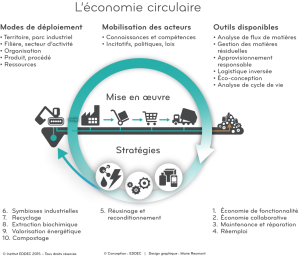
Source: Institut EDDEC http://instituteddec.org/themes/economie-circulaire/#1478637474475-2c0d9976-6af5
The context statement grabs our attention right away: “It is estimated that every year the world’s population consumes more renewable resources than the planet can generate”. Don’t be taken aback by the numerous concepts – collaborative economy, circular economy, economy by sharing, industrial symbiosis, etc. – as the definitions are still evolving, and there is yet no global consensus at this time. The key objective is to review and rethink the ways we currently function as consumers, companies and society in order to create value for everyone in a sustainable way.
According to the Institut EDDEC, the circular economy is “a system of production, exchange and consumption aiming to optimize the use of resources at every stage of the lifecycle of goods or services, by reducing the environmental footprint and contributing to the wellbeing of individuals and communities”.
Inspiring Examples
What could be the benefits for your business?
There are many challenges to a successful implementation of the circular economy model on a global or even regional scale (starting with the engagement of all the parties involved). However, just the reflection can become a reality check for companies and help them re-examine their operations. To begin, let’s look at your organization as a system where each step has a potential for optimization in order to cut down emissions and to boost added value. Can this system be expanded from the supplier to the consumer? Are there companies near you that could use your by-products as their raw materials and vice versa?
Authors: Under the direction of Sébastien Sauvé, Daniel Normandin and Mélanie McDonald
By Marie-Josée Roy, Eng., M.Env.
Expert in Strategic Management, Performance and Durability
Totem Performance organisationnelle
In his book “Your Brain at Work: Strategies for Overcoming Distraction, Regaining Focus, and Working Smarter All Day Long”, David Rock helps us understand our brains a little better and gives insights into how the natural functioning of the brain affects our ability to keep focus and to avoid distractions, in other words, how to boost performance and stay effective all day long. The author uses simple terms to explain complex brain science. The book is structured like a play, watching the two main characters go through many of the same challenges we all face at work. Each situation is followed by easy-to-understand strategies and practical tips drawn from neuroscience, and then the same scene is “reenacted” with the application of the techniques to optimize brain functioning. We travel inside the brains of the two characters as they learn to survive, succeed and strive in today’s overwhelming work environment, and thus learn about our own brains at work.
The book explores issues such as:
Following a couple of professionals through their daily challenges and explaining applicable neuroscience concepts, the author reveals surprising facts about the functioning of our brains. For example:
This book is highly recommended for all people with busy lives, who have to juggle between their work, family, marriage, leisure, etc., in short, for the majority of us.
Author: David Rock
Sylvie Grégoire, MBA, CRHA
President, Totem Performance organisationnelle
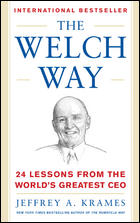 In this book, we learn the 24 key points that allowed Jack Welch, the eighth youngest CEO in the history of General Electric, to revolutionize the company and transform it into a highly successful corporation. Here are some of the points that particularly appeal to me.
Face Reality
When Mr. Welch became the CEO of GE, everyone insisted that the company was doing very well. Despite the fact that it was indeed one of the most successful corporations in the United States, Jack Welch noted that it had lost much of its market value and was buried under bureaucratic burden. He decided to shake things up in order to gain a clear view of the reality, with no illusions.
Simplify
Simplifying was one of the keys to his success. He did his best to make the company’s processes uncomplicated. For Welch, self-confidence is essential to achieve simplicity. And self-confidence needs an informal context to reach its full potential. So he cut through the bureaucratic noise to:
“You can’t believe how hard it is for people to be simple, how much they fear being simple… Clear, tough-minded people are the most simple.”
See Change as an Opportunity
Most people do not like change. Change also happens a lot faster than most companies can cope with. Since Mr. Welch wanted to change GE products, attitudes, behaviors, etc., he did everything he could to make change a reality by sending the following messages to the employees:
Defy Tradition
According to Jack Welch, people must take destiny into their own hands; otherwise it is destiny that will have the upper hand. Here are his tips:
“Shun the incremental and go for the leap.”
Live Speed
Mr. Welch blew all administrative blocks up to increase the company’s decision agility. He tried to infuse the corporate culture with the soul of a small business, and he succeeded by:
Eliminate the Boundaries
The CEO eliminated the barriers than stood between the employees and their ideas, between different departments, etc.
“Leading a big company… means never allowing to take yourself too seriously, and reminding yourself constantly… that yesterday’s press clippings often wrap today’s fish.”
In short, this book illustrates the concepts we know in theory, but that actually proved to be a source of great success for GE.
Author: J. Krames
Sylvie Grégoire, MBA, CRHA
President, Totem Performance organisationnelle
This book reminded me of another one of my favorites, Business Model Generation by Alexander Osterwalder & Yves Pigneur, from the point of view of its practical application. It contains a host of methods presented in simple practical terms to help service organizations rethink their way to serve clients. The author focuses on optimizing the “ecosystem” by improving the interactions between the different actors in the company. While many of these methods would be even better implemented, with more profound results, if the company uses the services of an expert in the field, they still help to make an in-depth analysis of the client needs in the future and to find innovative ways to meet the demand. Here is an overview of the methods that caught my attention:
Visualizing Drivers of Change
Based on the famous PESTEL analysis, this method helps participants to identify the drivers of change that are likely to shape the issues in the future, to bring participants to picture their business in 3 years, 5 years and 10 years. This method helps the team to see things from a different perspective and to create opportunities that support creativity and decisions in the present in order to meet the needs of their clients in the future.
Mapping Innovation Ecosystems
This method motivates participants to identify the diverse interactions and roles of the actors involved, such as employees, clients, partners, etc., and then to create a visual presentation to better understand the current ecosystem and, above all, to explore what could happen in the future. I believe this method creates the most value. Only too often employees do not fully understand the specific expectations and needs of various departments within the company, causing a host of issues, unnecessary expenses and lost opportunities.
Mapping the User Experience
In my practice, I saw many tools and methods used to map customer experience. Up until now, I did not find one that would meet my needs, while being both strategic and convenient. This method won me over right away because it allows building, step by step, an understanding of the diverse interactions and gaps, starting from client expectations and all the way to opportunities for improvement and innovation.
Segmenting by Meaning
This method helps to create a framework that distinguishes between various key types of clients, divided based on understanding what they are, what they want, why they want it, how they want it, etc. Creating a sound segmentation is definitely the first step to building an outstanding client experience. It is at the basis of the maximized customization of services in order to generate drivers of change.
Opportunity Mapping
This method prompts participants to crystallize their understanding of each of the drivers of change and emerging opportunities, as well as to position them in a particular time frame. The ultimate goal of this method is to allow implementation of profit-generating projects aligned to the opportunities.
Telling Stories
This method is based on presenting a change you wish to introduce through stories that have a clear structure. Moreover, it may be used to illustrate the steps that each actor would go through to become at ease with the suggested change. This method may be useful for change management, but above all to prevent resistance to change.
Service Blueprinting
This valuable method is used to analyze in every detail the existing service proposal through the interactions of actors. It brings into view the pitfalls and gaps in the current service system and helps to create and plan a new approach.
“The Service Innovation Handbook” written by Lucy Kimbell
Sylvie Grégoire, MBA, CRHA
President, Totem Performance organisationnelle
100 Business Rules You Must Break
 I was intrigued by the author’s unconventional business thinking. He dares to break the mold of traditional rules and wisdom, and challenges common concepts to deliver sharp insights and powerful advice to optimize various aspects of your business. Here are some of my favorite tips that I would like to share with you.
“The Devil’s Advocate: 100 Business Rules You Must Break” written by Caspian Woods
Sylvie Grégoire, MBA, CRHA
President, Totem Performance organisationnelle
