
FROM IDEA TO ACTION
Depression, burnout, boreout, brownout… Unfortunately, all these terms relating to lack of wellbeing among employees, leaders and business owners, are still a common presence in our everyday life. Companies are continuously working to boost their performance, to be more effective and efficient, while offering an organizational culture, work environment, remuneration systems and corporate values in today’s challenging context where companies have to compete for skilled workforce that is becoming increasingly scarce. It’s no easy feat! The very way to manage businesses and to lead people has to be rethought. We have seen a succession of management approaches like leadership coaching, participatory management, circular management, etc. Now the term Equitable Management is gradually making its way into organizations.
What Is Equitable Management?
According to the Association française du management équitable (Equitable Management Association of France – AFraME), equitable management is a set of practices rooted in the notion of achieving a fair balance between economic and/or operational performance of a company and personal fulfillment in the workplace. AFraME has put together a comprehensive Equitable Management Charter. Here are a few of these principles. (View the complete Charter) [i]
AMBITIOUS AND EXEMPLARY COMPANY
PEOPLE-CENTERED MANAGEMENT
RESPONSIBLE AND INVOLVED MANAGERS
ETHICAL AND SOCIAL COMPANY
People Are at the Center of Equitable Management
The principles that form the foundation of equitable management are commendable. The main goal is to put people first. So far so good. I’m sure that most of us would agree with this. However, it may get tricky when it comes to acting on it.
Any people-centered approach also implies relational and communicational challenges. Communication is and will be always a challenge at the heart of any organization regardless of the organizational culture, management practices and the best intentions of its leaders. Each person is unique. We have our own views, our experiences that make us who we are, our personality that defines us, our ambitions that guide us, our fears that hold us back, and our current personal reality that explains the difference in our perception of the same situation.
Interesting… But Gets Complicated
As if it were not already complicated enough, we also have fundamental needs that we are seeking to fulfill. Neuroscience identifies five basic human needs. While these are the same needs for all human-beings, the significance of each of them is different for every individual. According to the SCARF Model by the NeuroLeadership Institute[ii], the five basic human needs are (simplified SCARF Model):
S (Status) having a certain status, feeling that we have our place in the organization and being happy with it
C (Certainty) being able to foresee the future
A (Autonomy) having a certain level of control over our environment
R (Relations) having a relationship with other people, being part of a group
F (Fairness) feeling that we are treated fairly
In fact, when we find ourselves in a situation that does not meet or even negatively affects one or several of these needs, our brain perceives it as punishment or aggression, which leads to gradual disengagement or disillusion towards the situation, the colleague, the manager and the company. The opposite is true too. If we find the work environment fulfilling, we feel happier, more successful and engaged.
We observe strong coherence between the principles of equitable management and the SCARF Model. It leads me to conclusion that the principles of equitable management are a great solution for our basic human needs. Great! However, these principles, as great as they are, must be well supported by processes, rules, profound and sincere exchanges to ensure that everyone in the organization has the same understanding of their meaning, the same awareness of the basic needs of everyone involved not only prior to the implantation of the equitable management process, but on a continuous basis.
Life does not stand still. As people go through various situations such as economic challenges, family issues, etc., the weight of each of the basic needs would change accordingly. That would require having a mechanism in place that could ensure that the effects of any particular decision on each person are continuously taken into consideration and updated. One of the biggest mistakes would be to make assumptions based on previous experiences.
A Continuous Solution

In addition to integrating the principles of equitable management and considering the five basic human needs in the policies and procedures of your company, it is also recommended to set up a mechanism to address the human factor, such as a decision-making tool that would take into account the individuals who would be directly or indirectly affected by such decision, while bearing in mind the company’s mission, vision and values, as well as the principles of equitable management, the company’s objectives, and the SCARF needs of its employees and leaders. In the heat of the moment, it’s easy to forget the person!
Sylvie Grégoire, MBA, CRHA, NeuroLeadership Certificate
President, Totem Performance organisationnelle
[ii] http://www.neuroperformance.fr/le-modele-scarf/
 What would be a typical profile of an entrepreneur? Where does it all begin? Inspiration Inc. is the story of 10 successful entrepreneurs. They tell us about their paths and motivations towards their success in 2017.
As we read the book, we come to realize that there are as many types of entrepreneurs as there are business ideas. While all of these leaders have certain points in common, their approaches and reasons are unique. So, what do we take from this book? Regardless of our background and personality, we all have the potential to be an entrepreneur. If you have a good idea, if you “like risk, if you are an independent thinker, if you want to learn, if you have a great work capacity and an extraordinary focus”[1], then go for it! Don’t be afraid to dive into it!
Each of the 10 entrepreneurs will inspire and surprise you in their own way!
One day, Étienne Crevier, founder and CEO of BiogeniQ, asked his doctoral advisor how come with all the dollars invested in the genetics research we do not have access to all the knowledge? The answer he heard that day changed his life. “One day, we will.”[2] This was the trigger that started him on his journey as an entrepreneur.
Caroline Arnouk, founder of CPA Technology, explains that we must free up our ideas. The initial vision of a product or an idea must evolve to meet the market requirements. Being able to adapt and to stay flexible is essential in business!
Ethan Song created Frank+Oak. Recognized and admired by his peers, this businessman one day realized that staying true to your values and preserving your authenticity sometimes means that you cannot choose employees only based on their talents, but you must pick those who really share your vision.
Geneviève Nadeau founded Women In Mind as an answer to one of her own needs. Her mobile application is a social networking solution that links women in the neighborhood for mutual support and exchanges. While on her maternity leave, she came up with an idea to help women break out of isolation that some of them may live.
What makes Simon de Baene from GSOFT stand apart is the extraordinary workplace conditions that he offers to his employees: a skate ramp in the office space, unlimited vacations, two-week retreats to find innovative ideas, travel rewards, barber shop service directly at the office, etc. Mr. de Baene calls himself an atypical entrepreneur who designs an office environment where he would like to work himself. While some company leaders may consider these expenses somewhat crazy, in his eyes these are an investment into the performance, happiness and loyalty of his employees.
Connect&GO was created thanks to Dominic Gagnon who has positioned himself as a world leader in the field of event connectivity solutions. The Super Bowl, Jack Daniel’s, Budweiser, Just for Laughs and Osheaga are among his clients who selected his smart bracelet technology. All fans of smart technology will love reading about his business adventure!
Many of us got to know Amélie Morency when she introduced her company the FoodRoom on Dans l’œil du Dragon in the fall of 2016. She now operates a commercial coworking kitchen space. Despite some ups and downs, her tenacity and audacity have paid off. “We must knock on doors if we want them to open!”[3]
Stéphane Bédard and his company B-TEMIA brought sci-fi technology into the real world! B-TEMIA is the developer and manufacturer of Dermoskeleton technology to provide improved strength and autonomy to people with reduced mobility. This biorobotics company owes its success to its founder, Mr. Bédard, who made the most of the business advice and showed persistence in getting the support needed. He gives an interesting definition of an entrepreneur: “I believe that we, entrepreneurs, are social misfits a bit as well. Otherwise, if we were to fit in the mold of our society, we would probably not try to change it. Therefore, we must find our own place, our way to coexist with the society and to complement it.”[4]
Mnubo is a company focused on transforming the Internet of Things. You guessed it, Frédéric Bastien knew well how to put the wind in his sails! Throughout his years as an entrepreneur, Mr. Bastien learned that every company leader has two options: either hire people who are less intelligent than you to make your management task easier, or surround yourself with people who are more competent than you. According to him, by choosing the latter, we push our limits every day to keep up and stay motivated.
Many already know the name Martin-Luc Archambault, founder and CEO of AmpMe. He is one of the Dragons on Dans l’œil du Dragon. At only 35 years of age, he has already been the driving force behind the success of more than a dozen startups. According to him, there are no big or small entrepreneurs. “There are some very big entrepreneurs at the head of small businesses with three or four employees. They may not catch the attention of investors, but it is these small companies that fuel most of our economy and make our society prosper.”[5]
As we keep on reading this book, we realize that there is a debate going on whether we are born entrepreneurs or we become entrepreneurs. Yet everyone agrees that we must build a team of talented and driven people if we want to succeed. The book fulfils its goal to inspire its readers. Its style is simple and easy to understand. I think it is a must-read for teens and young adults too.
And here is an inspirational quote as a closing line: “An entrepreneur is not simply a business owner. An entrepreneur is someone who takes action and generates change.”[6]
Enjoy the book!
Mylène Grégoire
Communications and Web Marketing
Totem Performance organisationnelle
[1] Inspiration inc. Philippe Richard Bertrand et collaboration de Kim Rusk, p.142
[2] Inspiration inc. Philippe Richard Bertrand et collaboration de Kim Rusk, p.8
[3] Inspiration inc. Philippe Richard Bertrand et collaboration de Kim Rusk, p.92
[4] Inspiration inc. Philippe Richard Bertrand et collaboration de Kim Rusk, p.105
[5] Inspiration inc. Philippe Richard Bertrand et collaboration de Kim Rusk, p.129
[6] Inspiration inc. Philippe Richard Bertrand et collaboration de Kim Rusk, p.137 citation de Tim Ferriss, auteur de La semaine de 4 heures

When we get back home after work, what do we talk about with our significant others? Twenty per cent is about our professional accomplishments and 70 per cent is about our coworkers (what they have done or said, what they have not done or said)! And the remaining 10 per cent? Well, that would be for some quiet time, when nobody complains about a guy in the office next to yours or a new girl whose shirt is too revealing! Quality silence time… because too much energy during the day is wasted on office gossip.
These numbers are actually based on my own past experience and conversations with my colleagues. But I stay optimistic as everything leads me to believe that in 2018 balanced work relationships are becoming more common and easy. More and more, employees are looking for friendly work environments where human relationships are based on mutual respect and assistance. Some are even willing to accept a salary cut if it is the price to pay for an opportunity to evolve in an inspiring office setting…
There was once a workplace where all employees were friends and had healthy relationships founded on mutual respect. Everyone liked to highlight the qualities of their team members and learn from their peers to grow together. But one day, a new employee joined the team. She was obviously too pretty for the job (phone customer service rep!). That’s when everything went out of whack, setting in motion the wheels of the energy-sucking machine! It all started with one little comment casually dropped by someone at the office: “She must be related to the boss, otherwise why hire a girl whose skirt is so short it leaves nothing for imagination.”
I know from experience that a comment like this may be first but definitely won’t be the last one. Soon, like a magnet, it’ll attract others! Humans simply cannot resist the temptation to drop unnecessary and uncalled-for remarks. Fortunately, people don’t give in to bullying that easily anymore, bullying that is so common when we are kids. However, there are a few bad apples in every bunch, even nowadays: men and women who get carried away and join the wicked game of rumors…
Can it be nipped in the bud, before it’s too late? Sure! I am not a psychologist, but it seems to me that becoming part of an unhealthy office environment – and frankly, it applies to any situation in our lives – testifies to low self-esteem and lack of confidence in these people. When you hear an inappropriate comment, simply ask yourself if you will feel any better if you join in on it? Will you be happier? Instead, why not ask the “bad apple” for the true reasons behind this remark? Is it about seeking approval and validation from others?
I have to admit that once I found myself sucked into this destructive cycle too. Did I feel like I accomplished anything? I’ll let you guess. But I learned from this experience. Now, when I meet someone new, I try to know this person a little better as soon as possible, because I am 90 per cent certain that before long someone will make a critical remark about the newcomer. My trick now is to comment on a quality I saw in the new employee instead. This stops the critic short and even becomes an opportunity to change opinions and attitudes. We can all grow from our experience, evolve and realize that life is too beautiful to focus on the bad!
It is obvious that for a company manager, bad attitudes and workplace conflicts would be unwelcome. So do not ignore any destructive behaviors and negativity, even if you have your hands full with business tasks. It is easier to put a stop on it before the situation deteriorates by making it clear to the team that no inappropriate behavior would be tolerated. And if you feel you don’t have it under control, seeking external help could be a good solution.
The last point I want to make here, and I take it straight from the experience of Mylène Inc.: as a manager, always take the time to introduce the newly hired employee to your team, talk about her professional experience, skills, qualities and the reasons why she was selected for the job. It would be harder for the negative minds to find reasons to pick on this person! It goes without saying, you might think… Well, believe me, it doesn’t!
An easy way to introduce your new employee would be through a joint team activity. It doesn’t have to be elaborate, just a little get-together during your lunch break. Your employees would certainly appreciate it. Oh, I almost forgot… One last tip: make sure your new employee knows your office dress code.

So, which side do you prefer?
Mylène Grégoire

In Part 1 of this article we talked about the intricacy of neurological pathways behind the multitude of decisions we take every day. A franchisor’s decision-making process is a complex skill that can become a determining factor in the success (or not) of the network. So, let’s talk about the key challenges in decision making and consider several tips and tricks to mitigate hidden dangers:
Tip 1: Ask yourself if delaying a rush decision and taking some additional time would make the situation worse.
If the situation would remain about the same, why not give yourself a little more time to think it over and especially to gather key information for an informed decision? When emergency strikes, our reflex is to tackle issues on the spot. Yet taking a couple of hour to evaluate the situation and to weigh the components of our decisions can make a big difference in the quality of our problem-solving approach. We’re often told, “You should sleep on it” before making an important decision… And it’s true! It actually goes beyond taking the time to analyze the situation. When we’re fast asleep, our brain can tap into the vast potential of its network of microconnections and previous experience, and unconsciously search for solutions. That’s the trick behind the magic of waking up with an answer.
Tip 2: Reduce the risk of emergency decision making and problem solving.
Often, the very reason for emergency situations can be traced back to poor planning or a lack of process. Putting out fires clearly refers to that. If you find yourself in situations like that time and again then you might want to take a step back and have a good look at your current processes, rethink your methods and consider developing additional skills in order to limit this “fireman” approach.
Tip 3: Clarify with your network employees and franchisees the nature and the scope of decisions they can make, and establish a clear understanding of the parameters that should be considered.
Indeed, it often takes people several smaller cautious steps to understand what is within their decision scope. So why not simply spell it out for them? This way, everyone can assume their responsibility within the established framework. Besides if you want consistency across the network, all stakeholders must have the same decision-making tools and freedoms. For example, a decision would be considered “good”, if:
Tip 4: Give them the right to make mistakes.
Giving more leeway in decision making and problem solving also means that mistakes may happen. If you want people in your network to feel that they are responsible to find solutions and to take decisions, you must also make sure they know that they would have your support in case of possible mistakes. And I mean “real”, tangible support. Otherwise, they will continue to turn to you every time they feel there is a risk of being wrong.
Tip 5: Keep track of all decisions, both good and bad, and share the experience.
It would help you to avoid the same mistakes and to develop best practices within the network.
Tip 6: Involve people with complementary personalities and different contexts (including franchisees).
It would allow viewing the issue from all the angles and considering various aspects. It also helps to identify risks, to analyze the extent of associated risks, and to solve a complex issue. Another method is the Six Thinking Hats tool designed by Edward de Bono to analyze all facets of a problem and to counter our natural inclination to consider only one perspective. It is based on a simple parallel thinking process where all participants “put on” all six hats in sequence to challenge their modes of thinking and to explore new solutions.

Flexibility and creativity in decision-making will help the key players in your network to take responsibility, to change their habits and to make better decisions.
Sylvie Grégoire, MBA, CRHA, Certificate in NeuroLeadership
President of FlagFranchise and Totem Performance organisationnelle

Source: https://www.recyc-quebec.gouv.qc.ca/citoyens/mieux-consommer
We often hear that Quebecers are recycling champions. The 4Rs principle of sustainable development: Reduce, Reuse, Recycle and Recover… But today I would like to talk about the importance of the waste management hierarchy. Besides, I believe there is yet another R (Rethink) that must be added to the known 4Rs of waste management. It is about reviewing and rethinking our needs. It must become the very first step of resolving waste management problems. I’ll show you that we can transform costs into savings by moving away from the waste treatment approach towards waste prevention, or in other words by focusing on Rethink, Reduce and Reuse!
Question & Rethink
One SME leader working in the service sector told me that the challenge of “raw and waste materials management” is not relevant in the case of his company because there is already a recycling bin in every office. However, after we talked for a few minutes, we realized that all employees were scheduled to get a new laptop every 2 years.
Me: Why do you upgrade all laptops every 2 years? Is there a real need for it?
Manager: Silence… Well, it’s in the agreement we signed with our provider… But we do recycle the old ones!
Me: Do you think that you could both generate savings for your company and reduce the negative impact on the environment if you were to have your laptops upgraded based on the actual needs of your employees instead of a predetermined fixed replacement schedule?
You can imagine the rest of the conversation. This process of questioning your current business habits and rethinking your established processes can be done for all input (raw) materials. While responsible waste management is a good thing, it’s still waste treatment. Yet true cost savings are in prevention, which means focusing on and dealing with the input materials.
Does it sound familiar? What are the potential savings for your company if you review and rethink your consumption based on YOUR ACTUAL NEEDS?
The 5Rs – Recycling Hierarchy
So what is the waste management hierarchy all about? Here is a table that lists, in order of preference, the actions that are both profitable for your business and good for our planet.
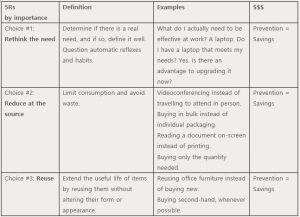
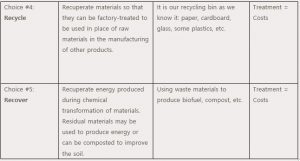
Based on: “Principes et mesures d’approvisionnement responsable: contribuer au développement durable par ses décisions d’achat” by STM (Principles and Methods of Responsible Procurement: Contribute to Sustainable Development through Purchasing Decisions) https://www.stm.info/sites/default/files/pdf/fr/appro_resp.pdf
All these options are better than landfills and disposal sites, but they are listed in order of importance and profitability. Indeed, goods that don’t have to be purchased because the need was rethought, their consumption was reduced at the source or they were reused (which imply savings), also do not have to be recycled (thus avoiding costs that result in savings).
Be a Responsible Business
On the website of the Ministry of Sustainable Development, Environment and the Fight against Climate Change we learn that:
”On average, Quebecers generate 25 tons of non-hazardous residual materials per minute. Despite the educational efforts and the means offered to the public, municipalities, as well as industrial, commercial and institutional establishments in order to enable them to reduce their production of goods and reclaim their waste, still too many consumer products are ending up in landfills and disposal sites…. In fact, some 13 million tons of residual materials produced in Quebec annually hold undeniable potential to be used both in the manufacturing of goods and for energy production.”
Reference: http://www.mddelcc.gouv.qc.ca/matieres/inter.htm
I absolutely agree with the idea of avoiding the landfill end of life of goods, but I would rather prefer to see the focus shifted towards the importance of the steps that precede recycling. Why not rename RECYC-QUÉBEC… to be more coherent… 5R-QUÉBEC? Seriously, whether you’re a manufacturing or service company, it is possible to focus on prevention by reviewing all input materials and goods to be able to offer your products/services, to organize events or to meet the needs of the employees: electronics, office furniture, cafeteria, bottled water, supplies, etc.
A simple way to get the attention of your colleagues is to give them the annual stats on the volumes and costs related to the management of residual materials (businesses are charged for recycling and trash containers and related services (quantity and price)). As we all know, the first step towards change is awareness.
Informed Decisions, Not Imposed Changes
Consumers and businesses alike have all the right to manage their own rate of consumption. It is up to us to identify our needs and to make educated choices in line with our values, our resources and our restrictions. What’s the link with the 5Rs of waste management? Enough with the culture of disposable goods and planned obsolescence! The very definition of sustainable development (“development that meets the needs of the present without compromising the ability of future generations to meet their own needs”) focuses on the “needs”. But what does a NEED mean? Having the latest iPhone model… is it a need or a want?
The problem starts when the “need” is imposed on us by planned obsolescence. Examples? According to the article on Planned Obsolescence published by GaïaPresse:
According to the same source:
Source: http://www.gaiapresse.ca/2018/01/obsolescence-programmee-grand-gachis/
So, how much do you think your company could save by simply applying the principles of this 5Rs hierarchy? I challenge you to make your own calculations…
Marie-Josée Roy
Sustainable Development & Strategic Management Expert
Totem Performance organisationnelle

I am just like everyone else! This is who I am. I have fears, desires, needs, questions that push me to go further and questions that, on the contrary, make me freeze in my steps and doubt my decisions!
Am I normal to ask myself so many questions? Is it even possible to ask too many questions? Which questions are considered to be reasonable? Which ones are the right questions? Do you see what I mean?…
In fact, all psychologists and key speakers agree: questioning is healthy and helps us advance, evolve and improve our relations with others and with our inner self. And therefore, it is not to be doubted or questioned!
Several months ago, I had to take some big decisions about my professional life. Decisions that keep me up at night, that prevent me from enjoying the present moment, but that are necessary… The details of why I found myself faced with these decisions are not important, but you should know that I appreciate my comfort and I respect my commitments. When I finally made up my mind to quit the job I had for 11 years, insomnia became my partner for better or for worse! But you know, when a new opportunity comes around like that, without us even looking for it (at least not consciously), we must put everything into question and rethink it all, we cannot ignore it!

So, I’ve been working with a new team for a few months now. I left behind a stable and comfortable job, my colleagues, my friends, many inspiring discussions during lunch hours, my bosses who knew me rather well, my job tasks and responsibilities that I practically knew by heart, my cute window office and a promising career!
I accepted a job offer from a young company, whose challenges had nothing to do with what I knew so well. Yet, it made me feel alive and passionate again. Now, I often work alone in front of my laptop; the other members of our team are on the road most of the time. There are some monthly meetings and exchanges with colleagues, but these are far from the subjects that I would love to discuss during my lunch breaks! I am fortunate to have the opportunity to work from home whenever I feel like it. And on these days, the glowing screen of my laptop is my only companion. This is as far as you can get from the passionate office cooler discussions I used to have! Each week, new tasks are added to my list, new responsibilities that I’ve never had before. Ideas rushing through my head at any time of the day, mostly when everyone else is fast asleep… but there is no paid overtime for this! Sometimes I miss my comfy emotional slippers, but I know they are gone. It was my choice as they became boring and I no longer felt sexy in them!
Would you have accepted a new career turn like this? Today, I can say it was the right decision. All my days are focused on the challenges that my new team give me. Every day I grow more passionate about these wonderful projects in which I believe with all my heart… But to be honest, it is not without doubts, fears and anxieties!
Some people are bold and audacious, they are real go-getters, they can easily dive into the unknown and take risks. And to them I say thank you for being there! You drive our beautiful society with your countless projects and you are an inspiration for the rest of us. We all know people like that. My boss is one of them! Others, me included, are more like cautious dreamers, whose aspirations are like a castle in the sky or a far-away planet! Do I go for it? Am I risking getting lost along the way? Would I be financially capable to keep my lifestyle? Do I have the guts for it? Would I be able to take the right decisions and do the right things, investing a part of me in this company and thus making a difference? Will my family be able to deal with the stress, joys and sacrifices that come with my new job? Do I have what it takes to live up to the expectations of my new boss? As I said, questions, questions, never-ending questions rushing through my head…
Whether you are a go-ahead type or one of those who question themselves during sleepless nights, you all have equal chances to make it in life. Your paths will be different, but the success of companies and organizations comes from the dedication of people of all sorts. Just be aware that if you decide to start a business or change jobs, these questions may not all have answers in the short term. And it may be for the better – that’s what keeps us alive and engaged! The unknown is not so bad after all!
You, bosses, will have to deal with all these personalities and find the potential in each of them. If an employee decides to leave the job for something new, you should see it as an opportunity to improve and to build on it. Yet not all managers would ask for the true reasons behind this decision to quit the job. I am talking here about getting to the bottom of things. An employee who is 100% happy would never leave. Thus it is a perfect occasion to understand the emotional dynamics and the real motivations for this departure. Are you ready to hear them and to make sure that other good employees do not follow in search of a better life? As a leader, you can’t please everyone, of course. There are constraints, regulations, agreements, etc. But understanding the internal issues that your employees live and willing to listen to them is already a step towards achieving happiness of your team members. A compromise is certainly a good solution, if possible. Each departure should lead to in-depth evaluation and reflection.
I must say that I’ve learned a lot since I started my new job. Above all, I realized that I must trust my instincts, sometimes listen to my heart and sometimes listen to my head. We often forget that there must be a dialogue between the two. Fears and questions are normal and fundamental, and must not be ignored. Sometimes, we should get out of our comfortable slippers and slide on a pair of new shiny shoes. You know, these beautiful new shoes that make us suffer at first, but also make us feel good about ourselves, powerful and ready to take on the world! Eventually they’ll be broken in, don’t worry… So, set aside a budget to update them when the time is right! During the times of doubt, ask yourself if you fear change or you fear failure. As Albert Einstein said, you never fail until you stop trying.
In conclusion, let’s review my motivations when I decided to go ahead and change jobs. Of course, my personal goal was to show that I could deal with the challenge, to learn new skills, to build my confidence and self-esteem, and to prove to myself that the blisters on my feet are not the end of the world if the journey is filled with happiness and discoveries! And also, each new person I meet on this path will be my source of inspiration and motivation to surpass myself.
Enjoy the road ahead! Stay alive and let life surprise you!
 Mylène Grégoire, expert in questioning!
We take millions of decisions, conscious and unconscious, every day, from easy ones such as putting one foot in front of the other one when we walk, reaching out to grab a cup of coffee, deciding to say hi to someone, to more complex ones such as choosing a franchise location or selecting franchisees.
The level of complexity of most situations and decisions in business is significantly higher, as well as the level of consciousness and cognition in business decision making. The more complex and conscious a decision is, the more likely it is to have a significant impact on the franchise network. So, how do we make sure we make the right decision? While there is no magic recipe, fortunately there are ways to optimize our decision-making process.
Memory and Effective Decision Making
First and foremost, our memory is a powerful tool. Information about decisions made is stored and used for future decisions, which means that our memory influences our decision-making process. The brain remembers that in a certain context our decision X led to the result Z. If the decision we took resulted in success, we subconsciously remember that.
Each decision helps create neural pathways in the brain, which will be subsequently used to support our judgment and decision-making tasks. As our decisions become more effective, we grow better, more skilled at making them. It is a trial and error principle. The brain continuously assesses and calculates the value of the decisions it makes. It builds an experience database, which improves the accuracy of predictions when it comes to evaluating the outcome of a certain decision. So, whenever the brain receives an error message, which means that the decision was incorrect, it would try a different behavioral pattern. The brain learns from its experience in order to speed up the decision-making process and to bring it to the level of automatism, even reflex. For example, if we get burnt once, the brain remembers that touching a hot surface would likely result in a burn. There is no need to touch a hot stovetop every time to see that it is painful. And what is even better, there is no energy spent on the decision not to touch it as our reflex prevents us from doing it.
It is important for the leaders who work in collaboration with the franchisor to become effective decision-makers to cut costs associated with poor time management and avoidable mistakes. Moreover, many decisions have a significant impact on the franchisor and on the entire network.
Key Decision-Making Challenges for Franchisors
Our decision-making process is quite complex and goes beyond repetitive tasks. Our emotional involvement, the context, social data are just some of the factors that affect our judgments and decisions. In addition, we are facing other challenges that make our decision-making process even more complex:
In short, decisions are obviously complex and energy-consuming. Given the impact they may have on the profitability of the franchise network, it becomes important to develop the skills of your leaders and to implement the right tools to improve the process.
Part 2 of this article, available in October, will give you several tricks and tips for effective decision making! Stay tuned!
Sylvie Grégoire, MBA, CRHA, Certificate in NeuroLeadership
President of FlagFranchise and Totem Performance organisationnelle
 As our elected officials return to office after their summer recess… This book, so accurate and current, will both entertain you and make you think. First of all, it combines the two subjects that I am passionate about, i.e. quality and sustainability. But also, the author masterfully uses humor and humanism to incite reflection while keeping it light and enjoyable. Mr. Chevalier wrote mainly for France, but his examples much resemble Quebec’s reality.
So what if our duty was to make public services HUMANLY performing…? The strength of the book is in showing the benefits of viewing an organization as a system of people and their interconnections, operating in a common environment and working towards a shared mission, instead of functioning in silos.
Throughout the book, the author proves that “there is no better introduction to sustainable development than through quality measures”! In part one, Mr. Chevalier goes back to the origins of quality. His examples help us understand the difference between a systemic approach and the use of isolated tools without considering individual contributors.
Our governments are literally drowning in “modernization” efforts(…) We can no longer consider them only with our logical, mechanistic and simplistic understanding(…) The systemic approach suggests that we take into account the connections and interactions between the various components of the system.
Whether at the educational, healthcare or municipal level, we see numerous reforms, centralization and restructuring efforts taking place. Yet, since the measures are “imposed” on individual players time and again without taking account of the system as a whole, the results are often lacking, while dissatisfaction among the key players is consistently present. (Quebec’s side note: the mixed results of lean projects when the tool is not integrated into the culture and the reality of the organization.)
According to the author, “the most realistic probability is that the concern for “work well done” must be as old as work itself.” This assumption that all people, regardless of their positions, want to deliver the best performance allows to focus on providing them with the means to “do the right things well”, which makes the link with the notion of added value.
In his book, Mr. Chevalier lists eight pillars of quality management:
As we go back to basics, the parallel with sustainable development becomes more evident. Sure, I would like to see the author trace direct links between the two notions, but he chose the route of addressing the difficulties to define sustainable development rather than focusing on the importance of seamless integration. “Sustainable development between ambiguity and fervent obligation.”
However, the book fulfills its purpose to make us reflect on the subject of sustainable development and to bring our vision to the next level in order to improve. And what if we apply this reflection to Integrated Health and Social Services Centers (CISSS) and Integrated University Health and Social Services Centers (CIUSSS) whose mission is to ensure accessibility, continuity and quality of services offered to the public in their sectors? Who are the key players and what are their concerns? How can we integrate service quality and sustainable development into the system’s operation, as well as their interfaces with the environment? What are the strong points we can use as the foundation to improve our services and develop a sense of belonging among our employees?
To be continued…
Book: La qualité publique durable: du “bien faire” au “mieux vivre”
By Gilles Chevalier
Marie-Josée Roy, Eng., M.Env.
Expert in Strategic Management, Performance and Sustainability
Totem Performance organisationnelle

Let me introduce myself: my employee ID Number is 04, I am a seasoned professional with rich work experience, most of it is rewarding and inspiring, yet some is frustrating and even annoying at times! However, every event and every encounter on my career path forges my character and builds my identity.
Through its blogs, Totem Performance Organisationnelle mainly targets organizational leaders. So, I decided to step in and speak on behalf of employees – those who are happy, those who are dissatisfied and even those who feel invisible in an organization where every team member must feel valued and appreciated.
I am talking to employees who, I am sure, can relate to what I want to say here, and above all, I am talking to Bosses, Presidents, Leaders, Owners, and to all those who have “important” titles in their electronic signatures. I address all business leaders, because I want to be heard! As an employee, I’ve lived many emotions and I know I’ll have many others to go through (retirement is not yet an option for me, my RRSP and investment accounts would not allow it yet!). And that’s what I’d like to talk with you about…
Dear bosses, when you table your decisions, do you always know how they affect your employees, their feelings and their state of mind? Don’t get me wrong, I don’t doubt your humanity. After all, most of you also go through ups and downs when making important decisions concerning us. But wouldn’t you like to really understand what some of your employees actually live on a daily basis? I’m talking about their feelings, from conflicting to happy, and everything in-between. Did you think that all your employees are completely frank when letting you in on what’s going on in their lives? Trust me, they are not, otherwise the unemployment rate would go through the roof.
So I’ll share my thoughts and my personal experience, as well as the experience of people whom I know and even those whom I hardly know, who wanted to talk to me about their professional and personal lives. And indeed, our personal and professional lives are closely connected, which makes your role of leaders even more complex! I would like to use the stories and testimonials of real people to bring to light the subject less talked about, that of the relationships between employees and their bosses, and even the relationships between employees. You might be surprised!
I hope you enjoy reading my articles. And I also hope they can make you think about the part of you that you had to put away to be a leader who does not let emotions get in the way of decision-making! And if this is the case, you should know that your employees, just like you, drag their emotional baggage back home with them after their workday is over… to the dismay of their loved ones and to the delight of family lawyers!
By the way, several years ago I made a choice and I’m no longer an employee with the ID Number 04. I am Mylène Grégoire. And it is my pleasure to share my world with you. It is the world I love to color with good humor and wit, but which is never far from the truth…

See you soon!
Mylène Grégoire
 Vacations are over, school is starting… this time of the year is synonymous with growing activity, launching new projects and picking up where you left off.
Autumn is in the air; cool breeze announces the change of seasons upon us. Since centuries, autumn has been often defined as the time that precedes old age. In Alchemy, it is symbolic of transition and culmination. It is a time to take stock of achievements and bounties, when the operation of the Philosophical Egg is brought to perfection.
We feel the bustle of life, at home and at work. We make the most of this season – when we are full of energy and vitamin D – to accomplish as much as possible, as if stocking up in preparation for the recluse of the winter months to come.
But as we throw ourselves into work, the wheels of day-to-day operations spinning faster, we tend to lose sight of our goals. That’s why it would be of great help to have a continuous reminder of where we intend to be. It is similar to a personal vision board… You know, the collage of trinkets, mementos and images we hang on the fridge where we can see it whenever we are in the kitchen, which represents our goals and wishes in life, in order to maintain our focus. Well, the same principle applies to our business objectives.
Visualization is a powerful mind exercise, gaining wide recognition for its results. But regardless of all the hype, it is still little applied in business. And yet it works… Olympic athletes have been using it for decades to improve performance. Research has revealed that visualization exercises and the actual physical activity trigger the same brain patterns. It is an efficient way to train our brains to create new neural pathways. And these new pathways can be only built through repetition.
Pausing a few times a day to view our goals, whether presented on a vision board or on the company’s Intranet page, can help identify and clarify our vision, and thus bring us closer to our goals.
But to be truly effective, this visual aid must fulfill a certain condition (as is the case with personal visual boards): it must generate emotions. We have heard it many times, read it in many books, like The Secret, right? It works because there’s a good reason – rationale – to that. We are emotional beings. After all, the emotional brain largely preceded the rational brain. And if there is opposition between feelings and conscious thoughts, it is always the emotional response that prevails.
So, your business goal of reaching certain annual sales is a purely rational, logical target. By adding an emotional dimension to it, which may be the subject of visualization sessions of your employees (for their individual and collective benefit), you may achieve surprising results. As an example, if the sales target is attained, employees would get their Friday afternoon off during the summer time (more time for themselves or with their families), or get access to the gym or spa (valuable personal time), based on their personal interests.
The higher the level of satisfaction of your employees, the more engaged and motivated they are. Thus adding an emotional aspect to the business goal could boost your overall organizational performance.
And according to Alchemy, it is the perfect time to transform matter into a higher form! So, what’s the risk in trying it?
Have a great beginning!
Isabelle Vincelette
Expert in Organizational Improvement
