Building your network: insights for effective franchisee engagement
The level of personal engagement and commitment of franchisees to your banner has an immediate effect on customer experience, as well as on the individual performance of your franchisees and on the overall performance of your network. While engagement is not something you can force upon anyone, here are several tips to help you inspire your franchisees.
“If it’s to be, it’s up to me.”
Dr. Robert Schuller, motivational speaker
ARE YOUR FRANCHISEES HAPPY?
According to a study by the Franchise Relationships Institute, 49% of franchisees say that their business drains them emotionally, and 43% do not have a balanced life. The impact of such dissatisfaction has a devastating effect on the wellbeing of their network. They are likely to be pessimistic, focus on issues rather than solutions, and have a negative effect on customers and other franchisees. In addition, they will be unreceptive to new ideas, do little to develop their own business or the network, and so on. In short, they would negatively impact everyone. Psychology studies identify three key components of employee satisfaction and happiness: 1) feeling competent, 2) feeling accomplished, and 3) having satisfying human relationships.
Also, the latest research in Neuroleadership, a fascinating branch of neuroscience, shows that, depending on whether the reality is consistent with our needs, our brain reacts in one of the two ways when exposed to situations or stimuli: engaging or disengaging. A disengaged franchisee feels anxiety, is on defensive, lacks constructive attitude, has low energy and little interest in his business, tends to doubt his franchisor, and is less likely to take risks. On the other hand, by meeting the needs of your franchisees, you boost their emotional and cognitive capacity. Just imagine the effects on your network!
5 Primary Needs According to Neuroleadership:
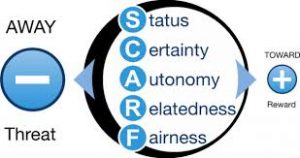
Status or relative importance to others
Certainty or security to be able to predict the future, to adapt
Autonomy to control your environment and to have choices
Relatedness to a group, the sense of safety with others
Fairness and justice or a perception of fair exchanges between people
TIPS AND INSIGHTS TO SATISFY THE 5 PRIMARY NEEDS
- Make sure your own needs are met, otherwise you will be toxic to your network.
- Choose the right franchisees for your network. Their skills, values and aspirations must be consistent with your vision. Favor quality over quantity, leverage the good ones by helping them grow and become multi-unit franchisees.
- Implement communication strategies that are in line with the network DNA, promote and celebrate success, formulate what is of value for the network and put your message across, but without infringing on their need for autonomy.
- Make sure that the training you offer is consistent with the actual needs of the franchisees and makes them more effective and autonomous in the management of their business.
- Draw a motivational map of your network to understand what drives your franchisees in order to match rewards with their expectations rather than with your idea of what is good for them or your own preferences.
- Map out franchisee experience across your network, similar to customer experience, and improve on it. Boosting franchisee experience (internal branding) will motivate their employees to work harder and increase their loyalty to the company, which in its turn will improve customer experience.
- Define your role as a franchisor and make sure you excel in what adds the most value to your network. Delegate or eliminate the rest! Do the same for your franchisees.
- Develop your confidence-inspiring leadership skills. Focus on what you can do for the network, not the other way around.
- Be forward-thinking. A stagnating network does not stimulate its franchisees, instead they become idle.
- Take the financial success of your franchisees close to heart, not just your own success.
- Document your franchise “formula”. The clearer it is, the easier it will be for your franchisees to focus on value-added tasks, which will translate in better performance and a higher level of satisfaction.
- Provide your franchisees with the necessary tools and training so that they could in turn engage their employees. Your network will be even stronger.
By applying these tips, you will improve your network’s engagement and commitment to your banner, but also you will create true brand ambassadors. Using an analysis tool, we can help you identify improvement priorities to boost your network engagement and loyalty level based on your particular business context and challenges.
Sylvie Grégoire, MBA, CRHA
President, Totem Performance organisationnelle
100 Business Rules You Must Break
 I was intrigued by the author’s unconventional business thinking. He dares to break the mold of traditional rules and wisdom, and challenges common concepts to deliver sharp insights and powerful advice to optimize various aspects of your business. Here are some of my favorite tips that I would like to share with you.
- Sleep in your car. One day, the owner of a well-known corporation and an outspoken advocate of lean management, was in a new city on a business trip. As he was looking for a place to stay for the night, he was frustrated with how much the local hotels were charging. So, he decided to sleep in his car instead, living his values and leading by example. What good is it to have strong principles and high values if the top management does not adhere to them?
- Leave stuff half-finished. The last 20% of any job are the toughest, but often could be easily delegated to others, thus freeing the manager to do things that have more value.
- Ask the bride to dance. Few people have the courage to approach top leaders or influencers. Yet, if you have a strategic message, go ahead.
- Sell invisibles. 70% of the value of a product is intangible in the eyes of consumers.
- Get your face slapped. If you are not failing at least one out of two sales calls, then you are not trying hard enough. Failing provides valuable learning experience.
- Stop making sense. To capture the attention of consumers, plan for a ‘strategically placed’ inconsistency in your branding or your product presentation. This little extra brain effort on their part will make your product last in their mind.
- Pay your staff to quit. Offer your new employees in training a monetary incentive to quit if they have doubts they are in the right place, because their lack of commitment to your company may hit you with big expenses in the future.
- Don’t recruit by experience. It is often better to hire an employee with less experience than an employee who has worked for a competitor and comes with a baggage of old habits and attitudes that might be tough to change.
- Send your team home. Today’s technology makes efficient long-distance work arrangement possible. Trust your employees, and they will be more grateful and productive.
- Don’t delegate – abdicate. Delegating responsibility is also about giving away authority that comes with it. Learn to let go!
- Fire the founder. Once the company has reached a certain maturity level, the founding entrepreneur is not always the best person to ensure further growth. Launch a new project and hand over your management functions.
- Pay yourself $1,500 an hour. Put your time into the tasks that bring most value rather than fall into the trap of “I do not have the means”. It would be wiser to hire an assistant at $15/hour and free up your valuable time to research new projects that would bring thousands of dollars.
- Disinherit your kids. Don’t offer them everything on a silver platter just because you have the means. Encourage them to work hard, from the bottom up, and to make a name for themselves.
- Cry as a negotiating technique. Mistakes happen. When a mistake occurs, don’t try to hide the damage from your customer. Offer a heartfelt apology and suggest remedies.
- Double your costs, halve your reward. Do it to validate the feasibility of your project. If your business plan is viable even under such pessimistic conditions, you might succeed!
“The Devil’s Advocate: 100 Business Rules You Must Break” written by Caspian Woods
Sylvie Grégoire, MBA, CRHA
President, Totem Performance organisationnelle
Last October, the Franchise Relationships Institute published the results of its research to measure the level of satisfaction among franchisees. About 28% of franchisees gave the thumbs down to their franchisor, naming poor relationship as one of the reasons. Few of us could claim to have nothing but positive and enriching personal relationship experience. Just imagine the complexity of establishing a win-win relationship between all players in a franchise network! The performance and growth of a network would be impossible without …