The level of personal engagement and commitment of franchisees to your banner has an immediate effect on customer experience, as well as on the individual performance of your franchisees and on the overall performance of your network. While engagement is not something you can force upon anyone, here are several tips to help you inspire your franchisees.
“If it’s to be, it’s up to me.”
Dr. Robert Schuller, motivational speaker
ARE YOUR FRANCHISEES HAPPY?
According to a study by the Franchise Relationships Institute, 49% of franchisees say that their business drains them emotionally, and 43% do not have a balanced life. The impact of such dissatisfaction has a devastating effect on the wellbeing of their network. They are likely to be pessimistic, focus on issues rather than solutions, and have a negative effect on customers and other franchisees. In addition, they will be unreceptive to new ideas, do little to develop their own business or the network, and so on. In short, they would negatively impact everyone. Psychology studies identify three key components of employee satisfaction and happiness: 1) feeling competent, 2) feeling accomplished, and 3) having satisfying human relationships.
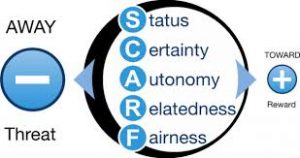
Also, the latest research in Neuroleadership, a fascinating branch of neuroscience, shows that, depending on whether the reality is consistent with our needs, our brain reacts in one of the two ways when exposed to situations or stimuli: engaging or disengaging. A disengaged franchisee feels anxiety, is on defensive, lacks constructive attitude, has low energy and little interest in his business, tends to doubt his franchisor, and is less likely to take risks. On the other hand, by meeting the needs of your franchisees, you boost their emotional and cognitive capacity. Just imagine the effects on your network!
5 Primary Needs According to Neuroleadership:
Status or relative importance to others
Certainty or security to be able to predict the future, to adapt
Autonomy to control your environment and to have choices
Relatedness to a group, the sense of safety with others
Fairness and justice or a perception of fair exchanges between people
TIPS AND INSIGHTS TO SATISFY THE 5 PRIMARY NEEDS
By applying these tips, you will improve your network’s engagement and commitment to your banner, but also you will create true brand ambassadors. Using an analysis tool, we can help you identify improvement priorities to boost your network engagement and loyalty level based on your particular business context and challenges.
Sylvie Grégoire, MBA, CRHA
President, Totem Performance organisationnelle
In Part 1, we discussed the main differences between advising and coaching in a franchise network. We also introduced the GROW model, a simple structure for coaching sessions, but warned against taking transitioning to coaching lightly. Becoming a coach involves many challenges that, once identified, make any franchise relationship more efficient. Here are some pitfalls and traps you might come across along your coach training path.
Coach Training Challenges
The Very Nature of a Franchise Network Is a Challenge for Coaching
Although we believe that support staff should become better at coaching, we also realize that it is not easy to implement this new philosophy in a franchise network. The solution lies in aligning these changes with specific strategies in order to generate interest among advisors to grow professionally, to develop their skills and to help franchisees recognize the advantages of the coaching method. Here are some key challenges:
Despite all the challenges, this change helps to create a stronger commitment to the banner in addition to improving franchisee performance. It transforms the role of area managers; their involvement becomes more strategic and oriented towards coaching.[1] It should be noted that in our opinion making coaching the only support approach does not fit the franchise network context. However, when used strategically, it can make a real difference in your network and, in the medium to long term, free up management resources to focus on fundamental strategic issues. As they perfect their coaching skills, area managers will be able to support franchisees in their efforts to become great coaches.
Learn the Subtleties of Coaching
There are several methods and strategies to hone the four steps of the GROW model, but first and foremost, to give your advisors the skills to convince your franchisees of the benefits of the coaching approach. An area manager must have effective coaching skills and must be able to judge when to act as a coach and when to be an advisor. Learning to apply the tools is only part of your success. These skills take practice. Lots and lots of practice.
Contact Totem Performance organisationnelle to learn more about our solutions to train your coaches and to optimize the effectiveness of your coaching efforts.
Sylvie Grégoire, MBA, CRHA
President, Totem Performance organisationnelle
© Totem 2016, All rights reserved
[1] GERSON, Keith, Training Your Trainers: Coach Your Support Staff for Improved Franchisee Performance